
US negotiates new military bases in Greenland
Denmark confirms talks as Washington seeks expanded GIUK Gap surveillance, proposal includes US sovereign territory on Danish-associated land
Images
 Vice-President JD Vance toured the US military's only base on the territory earlier this year
bbc.com
Vice-President JD Vance toured the US military's only base on the territory earlier this year
bbc.com
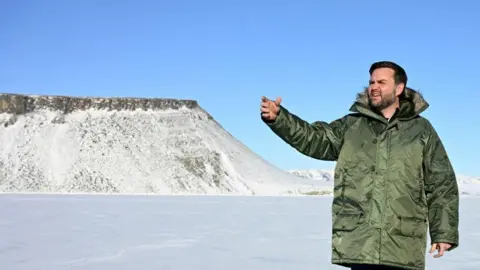 Vice-President JD Vance toured the US military's only base on the territory earlier this year
bbc.com
Vice-President JD Vance toured the US military's only base on the territory earlier this year
bbc.com
The US has been holding closely guarded talks with Denmark about expanding its military footprint in Greenland, according to the BBC, with proposals for three new bases in the island’s south. The discussions have progressed in recent months and have been handled by a small working group in Washington, the report says. A US official told the BBC the administration was optimistic the talks were moving in the right direction.
Greenland is a semi-autonomous part of Denmark, and the negotiations come after a diplomatic rupture triggered by President Donald Trump’s earlier threats to “own” Greenland and his suggestion it could happen “the easy way” or “the hard way,” according to the BBC. Danish authorities have publicly rejected the idea of any US seizure, and US officials have not raised taking control during the talks, the report says. Instead, the plan under discussion is a formalised expansion: US officials have proposed that the new bases be designated as US sovereign territory, according to a source cited by the BBC.
The practical case rests on geography and infrastructure. The bases would focus on surveillance of Russian and Chinese maritime activity around the GIUK Gap — the northern Atlantic corridor between Greenland, Iceland and the UK — a chokepoint that matters as submarine and surface traffic returns to strategic planning. One likely site is Narsarsuaq, on the location of a former US base with an airport; other sites would use existing airfields or ports to reduce costs, according to the BBC. That cost logic is also political: new construction would be visible on Greenland, while reusing facilities can be presented as “upgrades” rather than a new permanent presence.
The talks also underline how security policy can be rewritten without new treaties or votes, by narrowing negotiations to a handful of officials and then presenting the outcome as a technical adjustment. Denmark’s foreign ministry confirmed discussions were taking place but would not provide details, the BBC reports, while the White House confirmed high-level talks with Greenland and Denmark but declined to comment further. General Gregory Guillot, head of US Northern Command, referenced a push for more bases in congressional testimony in March, suggesting the military bureaucracy is already planning for a larger footprint.
For Denmark, the immediate trade is protection for sovereignty: a bigger US presence is sold as deterrence, but formal US “sovereign territory” on Danish-associated land would shift who ultimately controls access, policing, and rules on the ground. For the US, the deal offers a way to lock in strategic infrastructure in the Arctic while the administration’s attention is pulled toward the war in Iran, as the BBC notes. The two sides have not agreed anything yet, and the number and locations of bases could still change.
The BBC reports the teams have met at least five times since mid-January. One of the proposed sites is a small airport at Narsarsuaq, a reminder that the easiest way to build a new base is to reopen an old one.