
Mount Dukono eruption kills hiker on Indonesia’s Halmahera
Rescuers search for two missing Singaporeans after group climbed despite ban, exclusion zones prove easier to announce than enforce
Images
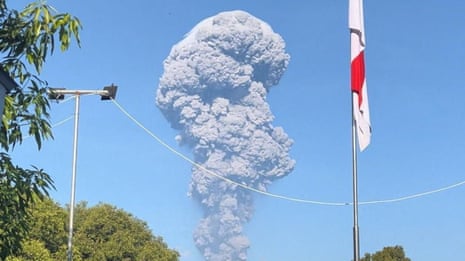
 A column of smoke rises into the sky after the eruption of Mount Dukono on a remote Indonesian island. Photograph: Jhon Frengki Manipa/Reuters
theguardian.com
A column of smoke rises into the sky after the eruption of Mount Dukono on a remote Indonesian island. Photograph: Jhon Frengki Manipa/Reuters
theguardian.com
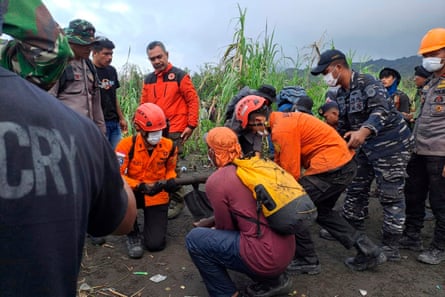 Rescuers recover a victim of the eruption of Mount Dukono on Saturday. Photograph: Basarnas/AP
theguardian.com
Rescuers recover a victim of the eruption of Mount Dukono on Saturday. Photograph: Basarnas/AP
theguardian.com
 Ash cloud rises from Mount Dukono eruption in Indonesia – video
theguardian.com
Ash cloud rises from Mount Dukono eruption in Indonesia – video
theguardian.com
Mount Dukono sent a 10-kilometre ash column into the sky early Friday on Indonesia’s remote island of Halmahera, after a group of 20 hikers set out despite an official climbing ban. By Saturday afternoon rescuers had recovered the body of an Indonesian woman, identified as Enjel, about 50 metres from the rim of the main crater, according to Associated Press reporting carried by the Guardian. Seventeen hikers were evacuated, including seven Singaporeans, while two Singaporean climbers remained missing.
The episode sits on top of a long paper trail of warnings that were easy to ignore and hard to enforce. Mount Dukono has been kept at Indonesia’s second-highest alert level since 2008, and the country’s volcanology agency recommended a four-kilometre exclusion zone around the active crater in late 2024. Local authorities went further in April 2024, closing all hiking routes to the volcano altogether; after Friday’s eruption, the national disaster management agency repeated that entering restricted zones could bring legal sanctions.
Yet the economics of risk on popular peaks do not stop when a route is “closed”. Tour operators and informal guides can still sell the trip, while the costs of a rescue—helicopters, drones, medical care, overtime—land on public agencies. The search operation on Saturday involved more than 100 personnel and drones, and was repeatedly constrained by continuing activity: the volcanology agency reported eruptions through late morning with ash columns rising to about 3,000 metres, and lava bursts were observed overnight.
The injuries among those evacuated underline how narrow the margins are near an active crater. Ten of the 17 survivors suffered minor burn injuries. Two Indonesians who were evacuated later joined the rescue effort and helped map routes for search teams, a reminder that local knowledge can be pressed into service after the decision to take the risk has already been made.
Indonesia’s geography makes these choices routine rather than exceptional. The country sits on the Pacific “ring of fire”, with more than 120 active volcanoes across an archipelago of more than 270 million people. That scale forces authorities to rely on advisories, exclusion zones and local closures that can be issued quickly, but not always policed in remote terrain.
On Saturday, rescuers focused on a roughly 700-square-metre area where they said they had found clues, while keeping distance from the crater as fresh ash plumes continued to rise. Enjel’s body was recovered within sight of the rim that had been marked off as a no-go zone.