
Péter Magyar becomes Hungary prime minister
Tisza landslide ends Viktor Orbán era after 16 years, EU flag returns to parliament as Brussels funds remain frozen
Images
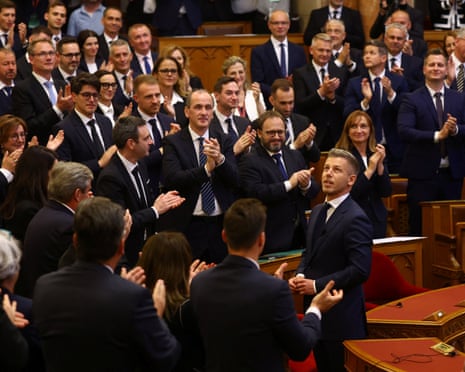 Péter Magyar receives a standing ovation in parliament during his swearing-in ceremony. Photograph: Bernadett Szabó/Reuters
theguardian.com
Péter Magyar receives a standing ovation in parliament during his swearing-in ceremony. Photograph: Bernadett Szabó/Reuters
theguardian.com
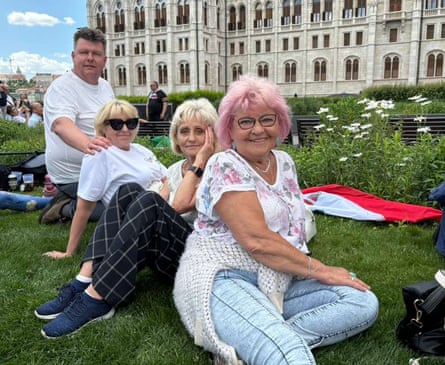 Left to right: László Makárdi, 50; Anikó Molnár Gyulán, 60; Erzsébet Medve, 68; and Marianna Szűcs, 70. Photograph: Flora Garamvolgyi
theguardian.com
Left to right: László Makárdi, 50; Anikó Molnár Gyulán, 60; Erzsébet Medve, 68; and Marianna Szűcs, 70. Photograph: Flora Garamvolgyi
theguardian.com
Péter Magyar is sworn in as Hungary’s prime minister on Saturday, ending Viktor Orbán’s 16-year run and installing the opposition Tisza party’s leader with a parliamentary supermajority. According to The Guardian, Tisza won 141 seats in the 199-seat parliament in an election held about a month earlier, giving the new government room to rewrite rules and personnel choices embedded over a decade and a half. The ceremony in Budapest drew crowds outside the neo-Gothic parliament building, cheering Magyar and booing Fidesz lawmakers as the inaugural session was broadcast on large screens.
The immediate signal to Brussels was symbolic but pointed: the newly elected speaker announced that the EU flag would be returned to the parliament building after Fidesz removed it in 2014, The Guardian reports. Magyar has said he wants to repair Hungary’s relationship with the EU and work to unlock billions of euros in frozen funds, money withheld over rule-of-law concerns that became a standing feature of Orbán’s later years. That creates a clear bargaining channel: Budapest can offer institutional changes that satisfy EU conditions, while the EU can release cash that a new government can use to stabilise budgets and show quick wins.
The harder work is domestic. Orbán’s government spent years placing loyalists across the judiciary, state administration and much of the media landscape, leaving a new cabinet with formal power but an apparatus that may not move at the speed it wants. Magyar’s own biography complicates the break: he was previously part of Fidesz’s elite before turning on the party in 2024, publicly describing how power and wealth had been accumulated inside the system. For supporters, that makes him a credible operator who understands where the levers are; for opponents, it raises the question of how much of the old network can be dismantled without triggering institutional paralysis.
Hungary’s shift also lands in a region where EU money, energy dependency and security policy are tightly coupled. A government seeking to normalise ties with Brussels is likely to prioritise predictable compliance and access to funding over the brinkmanship that made Hungary a recurring veto threat in EU decision-making. At home, expectations appear less ideological than practical: people interviewed by The Guardian spoke about underfunded schools, children moving abroad, and the hope that a change in government makes the country more “liveable” again.
Orbán, 62, will not take a seat in the new parliament—the first since Hungary’s 1990 democratisation without him in the chamber—and has said he will instead reorganise his movement. On Saturday, in front of the same building where crowds watched the swearing-in, Hungary’s new speaker announced the EU flag would fly again.