
Reform UK sweeps local councils across England
BBC projection puts Farage party on 26% national vote share, Labour and Conservatives tied as governance shifts to third-party hands
Images
 bbc.com
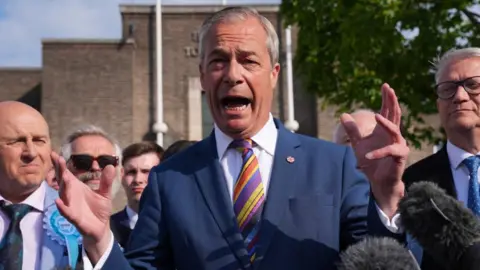 PA Media Nigel Farage addresses the media in Havering. He is stood in front of a group of Reform supporters and is wearing a blue jacket, a white shirt and a striped tie.
bbc.com
PA Media Nigel Farage addresses the media in Havering. He is stood in front of a group of Reform supporters and is wearing a blue jacket, a white shirt and a striped tie.
bbc.com
 Thin, red banner promoting the Politics Essential newsletter with text saying, “Top political analysis in your inbox every day”. There is also an image of the Houses of Parliament.
bbc.com
Thin, red banner promoting the Politics Essential newsletter with text saying, “Top political analysis in your inbox every day”. There is also an image of the Houses of Parliament.
bbc.com
Reform UK’s local-election surge has redrawn the map of British politics in places that used to be decided by habit.
According to the BBC, Nigel Farage’s party won hundreds of seats and took control of councils across England, including Havering in London, while also breaking through in counties such as Essex and Suffolk. In the Midlands and the north, Reform gained at Labour’s expense; in Wigan it won 24 of 25 seats contested, slashing Labour’s council majority. The same BBC analysis cites polling expert John Curtice projecting a national vote share from ward-level results that puts Reform at 26%, with Labour and the Conservatives tied on 17% and the Liberal Democrats on 16%.
The numbers matter less than where they came from. Curtice told the BBC that Reform’s strongest results were in areas that voted heavily for Brexit in 2016, a reminder that the 2019 Conservative takeover of parts of the “red wall” did not resolve the underlying voter coalition—those seats were simply rented for one election and then put back on the market. Farage is now claiming he can compete “from the southwest of England up to the northeast of Scotland”, and the council results give him local machines, budgets and patronage networks that did not exist when Reform was “in its infancy” at the last comparable cycle.
The immediate cost is being paid inside Labour. Swiss outlet Blick reports Labour lost nearly 1,000 seats in local and regional contests and that some Labour MPs have discussed whether Keir Starmer should resign within a year. Starmer has argued publicly that stepping down would throw the party into chaos, but local elections are where parties test their ground operation and where unpopular policy shows up first: bin collections, planning fights, and the daily friction of public services. When a protest party takes councils, it inherits those complaints—and gets to decide whose complaints are answered.
The second-order effect is pressure on both major parties to bid for the same voters with visible, enforceable promises, particularly on immigration and public order—issues where national rhetoric is cheap but implementation is mediated by agencies, courts and local capacity. Reform’s gains also complicate the Conservatives’ path back to relevance: a right-leaning challenger that can win in both Conservative and Labour areas turns many constituencies into three-way contests where small swings produce large seat losses.
In Havering and Wigan, the shift is no longer hypothetical: the party that campaigned against the system now has to run parts of it, starting with next week’s council meetings and the budgets already written.