
Trump says US Iran ceasefire holds
Centcom reports missiles drones and small boats fired at three US destroyers in Strait of Hormuz, uae air defences intercept launches as peace memo talks continue
Images
 bbc.com
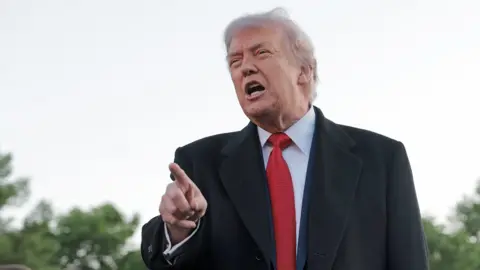 Anna Moneymaker / Getty Images US President Donald Trump speaks to reporters Lincoln Memorial Reflecting Pool in Washington DC.
bbc.com
Anna Moneymaker / Getty Images US President Donald Trump speaks to reporters Lincoln Memorial Reflecting Pool in Washington DC.
bbc.com
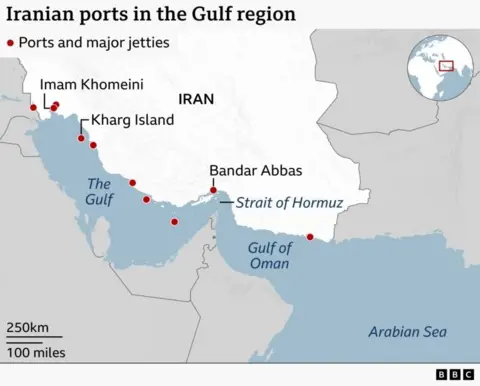 Map titled “Iranian ports in the Gulf region” showing Iran’s southern coastline along the Persian Gulf and the Gulf of Oman. Ports and major jetties are marked with red dots, including Imam Khomeini, Kharg Island and Bandar Abbas. The Strait of Hormuz is labeled between the Gulf and the Gulf of Oman, with surrounding waters and the Arabian Sea shown in blue. Iran and neighbouring land areas are shaded grey, with a distance scale in kilometres and miles and a BBC logo in the bottom right corner.
bbc.com
Map titled “Iranian ports in the Gulf region” showing Iran’s southern coastline along the Persian Gulf and the Gulf of Oman. Ports and major jetties are marked with red dots, including Imam Khomeini, Kharg Island and Bandar Abbas. The Strait of Hormuz is labeled between the Gulf and the Gulf of Oman, with surrounding waters and the Arabian Sea shown in blue. Iran and neighbouring land areas are shaded grey, with a distance scale in kilometres and miles and a BBC logo in the bottom right corner.
bbc.com
A month-old US–Iran ceasefire was tested again on Friday after US Central Command said Iranian forces fired missiles, launched drones and sent small boats at three US Navy guided-missile destroyers transiting the Strait of Hormuz. President Donald Trump insisted the ceasefire still held, even as Centcom said it struck Iranian launch sites and other military nodes in retaliation, according to the BBC.
The clash lands in a narrow space between diplomacy and blockade. Iran’s foreign ministry said this week it was considering a US proposal to end the war, and Axios has reported that Washington believes it is close to a memorandum of understanding that would set a framework for further nuclear talks. At the same time, the fighting is happening in the exact corridor where the United States has tried to turn maritime control into negotiating leverage: warships escort and interdict, insurers reprice risk, and commercial operators decide whether a voyage pencils out. Each exchange of fire makes the “ceasefire” less like a pause and more like an argument over who gets to define normal shipping.
The public narratives are built to support that contest. Centcom described the Iranian attack as “unprovoked” and said US forces “eliminated inbound threats” before targeting facilities tied to the strikes. Iranian military commanders, by contrast, alleged US “aerial attacks” hit coastal areas including Bandar Khamir, Sirik and Qeshm Island, and accused Washington of violating the truce; Iranian state media initially described an “exchange of fire” in the strait. The UAE’s defence ministry added a third data point, saying its air defences were actively engaging missiles and drones launched from Iran, with three moderate injuries reported.
For mediators, the problem is not a shortage of proposals but a shortage of enforceable boundaries. Pakistan has been positioned as an intermediary, and Iranian officials have said their response to the latest US offer would be shared via Pakistani channels, the BBC reports. Yet the incentives at sea reward brinkmanship: a missile launch that misses can still raise shipping costs, tighten credit terms for cargoes, and pressure third countries to lean on whichever side is most exposed to trade disruption.
Trump’s own messaging reflects the dual track. He wrote that Iran had “trifled with us today” and warned that future US strikes would be “a lot harder, and a lot more violently” if Iran does not sign a peace deal quickly. The ceasefire, in other words, is being sold as intact while being used as a deadline.
None of the US warships were hit, the BBC reports. But the strait again produced the same outcome: a declared truce that still requires air defences, retaliatory strikes and fresh warnings to keep it in place.