
Myanmar says Aung San Suu Kyi moved to house arrest
State media airs single photo as lawyers report no notice, location kept secret
Images
 State TV broadcast a picture of the Nobel laureate in confinement
bbc.com
State TV broadcast a picture of the Nobel laureate in confinement
bbc.com
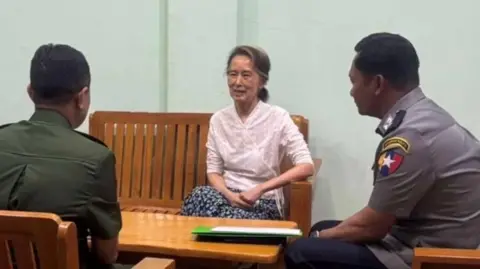 State TV broadcast a picture of the Nobel laureate in confinement
bbc.com
State TV broadcast a picture of the Nobel laureate in confinement
bbc.com
Myanmar’s military said it has moved Aung San Suu Kyi to house arrest after more than three years out of public view, broadcasting a single photograph of the 80-year-old seated beside two uniformed personnel. According to the BBC, coup leader Min Aung Hlaing said her remaining sentence had been commuted to be served at a “designated residence”, without disclosing an address. Suu Kyi’s lawyers told Reuters they had received no direct notification, and her son Kim Aris said the image shown was taken in 2022 and provided no proof she is alive or where she is being held.
The announcement lands as the junta tries to sell a picture of normalisation: an election earlier this year produced a nominally civilian government while leaving the same generals in charge, and the regime has pointed to recent battlefield gains against armed opposition groups. Suu Kyi’s disappearance has always been part of the machinery—trials held under military control, charges widely dismissed as fabricated, and a sentence that once totalled 33 years and has been reduced in stages. Moving her from a military prison to an unspecified house does not remove that machinery; it changes the optics and the logistics. A prisoner in a cell is a liability for foreign governments and aid agencies looking for a reason to keep distance; a prisoner in a residence can be presented as “humane” while remaining unreachable.
The uncertainty is also functional. If family, lawyers and independent observers cannot verify her location or health, the regime can float signals of leniency without paying the price of actual access. Sean Turnell, an Australian economist who served as Suu Kyi’s economic adviser and was detained after the 2021 coup, told the BBC that the regime is running a public-relations campaign to convince the world it is legitimate. Turnell described prison conditions as “medieval”, with poor food and medical care and cells open to the elements—conditions that become politically costly when attached to an 80-year-old Nobel laureate. House arrest, by contrast, is easier to market and harder to audit.
For Myanmar’s opposition, the move offers no clear opening. Suu Kyi’s earlier years under house arrest helped build her status as the face of non-violent resistance, but today’s conflict is fragmented, armed, and fought across regions where communications are unreliable and institutions have been hollowed out. For outside actors, the same ambiguity that protects the junta complicates any response: sanctions and diplomatic isolation are blunt tools, and humanitarian engagement risks becoming a channel through which the regime launders its own narrative.
The junta has shown one photograph and named no residence. Suu Kyi’s family says they still have no way to contact her.