
Spain prepares Canary Islands reception for MV Hondius hantavirus cases
WHO says Cape Verde lacks evacuation capacity, cruise tourism meets ad hoc quarantine corridors
Images
 bbc.com
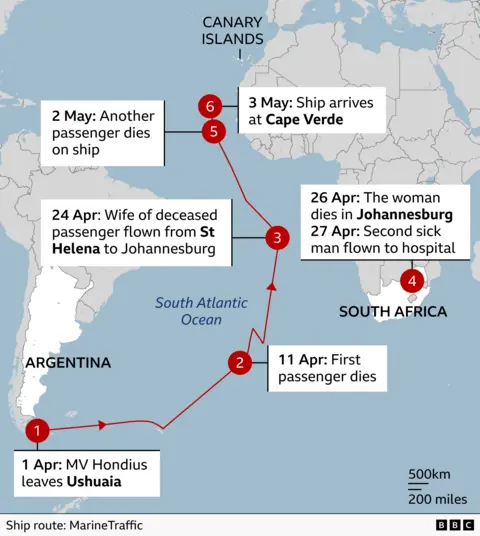 Map tracing the route of the cruise ship MV Hondius across the South Atlantic, with numbered points marking key events. The ship leaves Ushuaia, Argentina on 1 April, a first passenger dies on 11 April, the first passenger's wife leaves the ship at St Helena on 24 April and dies in Johannesburg on 26 April, and another sick man is flown to Johannesburg on 27 April, another passenger dies on board on 2 May, and the ship arrives at Cape Verde on 3 May. The route is shown with a red line, dates and notes in text boxes, and reference locations including South Africa, the Canary Islands, and the South Atlantic Ocean.
bbc.com
Map tracing the route of the cruise ship MV Hondius across the South Atlantic, with numbered points marking key events. The ship leaves Ushuaia, Argentina on 1 April, a first passenger dies on 11 April, the first passenger's wife leaves the ship at St Helena on 24 April and dies in Johannesburg on 26 April, and another sick man is flown to Johannesburg on 27 April, another passenger dies on board on 2 May, and the ship arrives at Cape Verde on 3 May. The route is shown with a red line, dates and notes in text boxes, and reference locations including South Africa, the Canary Islands, and the South Atlantic Ocean.
bbc.com
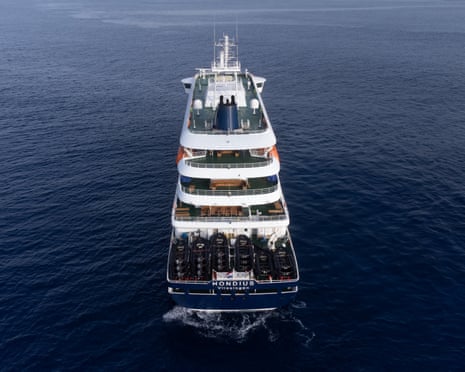 There have been a total of seven suspected cases of hantavirus onboard the MV Hondius, including three people who have died. Photograph: AFP/Getty Images
theguardian.com
There have been a total of seven suspected cases of hantavirus onboard the MV Hondius, including three people who have died. Photograph: AFP/Getty Images
theguardian.com
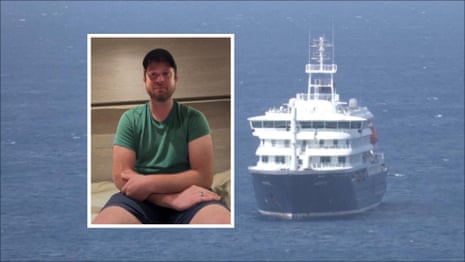 Cruise passenger appeals for help after suspected hantavirus outbreak - video
theguardian.com
Cruise passenger appeals for help after suspected hantavirus outbreak - video
theguardian.com
Seven suspected hantavirus cases and three deaths on the Dutch cruise ship MV Hondius have pushed Spain into an improvised role as the nearest high-capability medical backstop. According to the BBC, the ship—carrying roughly 149 people from 23 countries—left Argentina about a month ago, docked off Cape Verde, and is now expected to reach the Canary Islands in three to four days, with Gran Canaria or Tenerife among the likely destinations.
The immediate problem is not only treatment but logistics. The World Health Organization has said Cape Verde cannot carry out the medical evacuation operation, leaving Dutch authorities to oversee urgent airlifts for two crew members, including the ship’s doctor, who are suffering respiratory symptoms, the Guardian reports. Spain’s health ministry has said passengers and crew will be examined on arrival and moved through “special spaces and transports” designed to avoid contact with the local population—essentially turning a tourist gateway into a temporary quarantine and transfer hub.
Hantavirus is typically contracted from rodents, but WHO officials have raised the possibility of spread among close contacts on board, a detail that changes the risk calculus for enclosed settings like cruise ships. Even if the public risk is described as low, the operational risk is high: a handful of cases can immobilise an entire vessel, require international consular coordination, and force a coastal health system to create controlled corridors for people who still need food, staff, cleaning, and onward travel.
The passenger list also shows how quickly a shipboard outbreak becomes a multi-state responsibility without a clear command structure. The BBC notes nationals from more than 20 countries are on board; the Guardian says the UK has set up consular teams across the UK, South Africa, Spain and Portugal to support Britons, while one British passenger previously evacuated to Johannesburg remains in intensive care. Each step—medical evacuation, port access, onward repatriation—depends on who has aircraft, beds, legal authority, and willingness to absorb the political blame if containment fails.
Cruise operators sell mobility and tight scheduling; outbreaks turn mobility into the liability. With passengers asked to remain in cabins while disinfection and public health measures continue, the ship’s normal routines become a compliance problem, and the destination’s normal border rules become a health policy instrument.
Spain’s health ministry says the MV Hondius will be received in the Canary Islands within days. The ship is still at sea, but the quarantine infrastructure is already being built on land.