
WHO probes hantavirus cluster on MV Hondius
Seven cases and three deaths trigger medical evacuations off Cape Verde, shipboard rules tighten even as officials say public risk is low
Images
 Medical teams from Cape Verde supported by the WHO have boarded the ship to help with the suspected cases
bbc.com
Medical teams from Cape Verde supported by the WHO have boarded the ship to help with the suspected cases
bbc.com
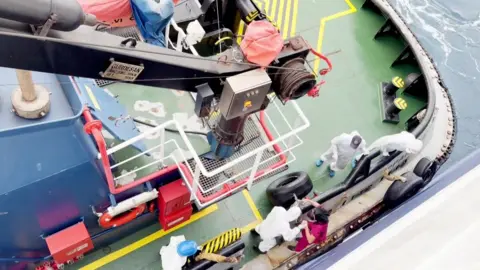 Medical teams from Cape Verde supported by the WHO have boarded the ship to help with the suspected cases
bbc.com
Medical teams from Cape Verde supported by the WHO have boarded the ship to help with the suspected cases
bbc.com
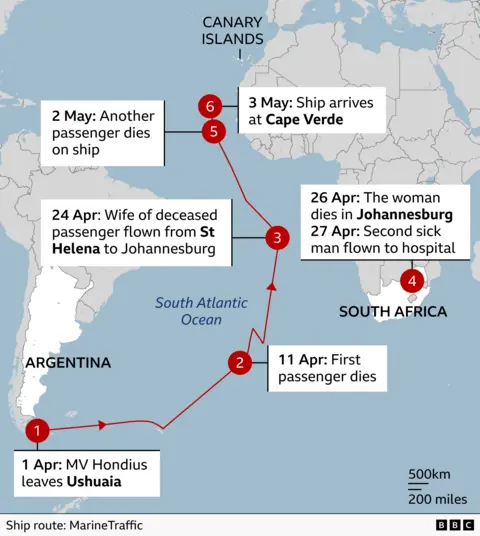 Map tracing the route of the cruise ship MV Hondius across the South Atlantic, with numbered points marking key events. The ship leaves Ushuaia, Argentina on 1 April, a first passenger dies on 11 April, the first passenger's wife leaves the ship at St Helena on 24 April and dies in Johannesburg on 26 April, and another sick man is flown to Johannesburg on 27 April, another passenger dies on board on 2 May, and the ship arrives at Cape Verde on 3 May. The route is shown with a red line, dates and notes in text boxes, and reference locations including South Africa, the Canary Islands, and the South Atlantic Ocean.
bbc.com
Map tracing the route of the cruise ship MV Hondius across the South Atlantic, with numbered points marking key events. The ship leaves Ushuaia, Argentina on 1 April, a first passenger dies on 11 April, the first passenger's wife leaves the ship at St Helena on 24 April and dies in Johannesburg on 26 April, and another sick man is flown to Johannesburg on 27 April, another passenger dies on board on 2 May, and the ship arrives at Cape Verde on 3 May. The route is shown with a red line, dates and notes in text boxes, and reference locations including South Africa, the Canary Islands, and the South Atlantic Ocean.
bbc.com
Seven hantavirus cases have been identified on the Dutch cruise ship MV Hondius, with three deaths reported during the voyage and two crew members now slated for medical evacuation. The World Health Organization said there may have been rare human-to-human transmission among “really close contacts” on board, according to the BBC, even though hantavirus is usually caught from rodents.
The ship, which left Argentina about a month ago, is anchored near Cape Verde off West Africa while medical teams supported by the WHO test passengers and crew. About 149 people from 23 countries remain aboard under strict precautionary measures; the UK government says around 20 British nationals are on the vessel. Images published by the BBC show workers in hazmat suits approaching the ship from a smaller boat as disinfection work continues.
The working assumption, the WHO said, is that the Andes strain of hantavirus is involved in the two confirmed cases. That matters because Andes virus—unlike most hantaviruses—has documented person-to-person transmission in South America, typically requiring prolonged close contact. WHO official Dr Maria Van Kerkhove told reporters the hypothesis is that “a couple of different types of transmission” may be occurring: an initial infection before boarding, potential exposure during shore visits to islands with rodents, and possible spread between close contacts on the ship.
The case details underline how quickly a clinical problem becomes a jurisdictional one at sea. The two confirmed cases are a Dutch woman, who is among the deceased, and a 69-year-old UK national who was evacuated to South Africa for treatment. The Dutch woman’s husband also died but is not a confirmed case. A German national died on 2 May but is likewise not confirmed, and a person associated with that German passenger is expected to be evacuated alongside the two symptomatic crew members.
Spain has granted permission for the Hondius to dock in the Canary Islands for risk assessment and further monitoring, but Spain’s health ministry has publicly downplayed speculation that it will accept the ship immediately. Instead, it told the WHO that the next stop will be decided based on epidemiological data gathered as the ship travels past Cape Verde.
The WHO stressed that the risk to the wider public remains low. On the Hondius, however, the containment rules are already concrete: symptomatic passengers and those caring for them are using full personal protective equipment, while the rest of the ship waits for test results and a port willing to take responsibility.
The WHO also said it had been informed there were no rats on board.
For now, the outbreak is being managed in the space between two coastlines, with the ship’s itinerary effectively replaced by a rolling risk assessment.