
Israel intercepts Gaza aid flotilla near Crete
Global Sumud convoy says boats seized in international waters, European capitals demand releases as blockade enforcement moves west
Images
 Israeli forces board humanitarian flotilla boats more than 600 miles from Gaza – video
theguardian.com
Israeli forces board humanitarian flotilla boats more than 600 miles from Gaza – video
theguardian.com
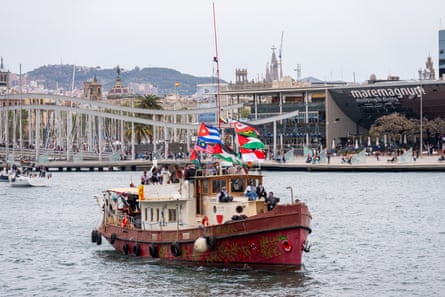 Vessel during a symbolic sendoff for the Global Sumud Flotilla in Barcelona earlier this month. Photograph: Joan Mateu Parra/AP
theguardian.com
Vessel during a symbolic sendoff for the Global Sumud Flotilla in Barcelona earlier this month. Photograph: Joan Mateu Parra/AP
theguardian.com
Israeli naval forces intercepted and detained crews from more than 20 Gaza-bound aid boats near the Greek island of Crete this week, according to The Guardian. Organisers of the Global Sumud Flotilla said at least 22 vessels were stopped in international waters more than 600 miles from Gaza, with roughly 175 activists taken into Israeli custody. Israel’s foreign ministry said the boats were offered a choice: turn back, or proceed to the Israeli port of Ashdod if they were carrying humanitarian aid.
The episode widens a familiar Gaza blockade dispute into a Mediterranean problem for European capitals. The flotilla, described by organisers as a 58-vessel effort with participants from over 70 countries, sailed from Italy on Sunday; among those detained were French nationals including Paris municipal councillor Raphaelle Primet. Within hours, the incident produced a stack of official reactions: Turkey’s foreign ministry called the interception “piracy,” Italy’s prime minister Giorgia Meloni demanded the release of Italians onboard, and Francesca Albanese, the UN special rapporteur for the West Bank and Gaza, publicly questioned how seizures near Europe are being treated as routine.
Israel framed the flotilla as more than a humanitarian gesture. Defence minister Israel Katz said he had imposed sanctions on the flotilla, alleging it was organised by Hamas in cooperation with other international organisations. That claim, whether substantiated or not, is a useful legal and political tool: if a civilian convoy can be reclassified as an extension of an enemy group, naval interdiction becomes a security operation rather than a diplomatic provocation.
The organisers’ account points to another layer: control of information. They alleged communications jamming, smashed engines and destroyed navigation equipment, leaving boats powerless as a storm approached. The Israeli military declined to comment on those specific accusations, but the basic reality remains that once a state can physically seize vessels, it can also decide what footage gets out, who speaks to journalists, and which versions of events are documented first.
Israel’s foreign minister Gideon Saar later said activists would be transferred to Greece “in coordination with Greek authorities,” suggesting a managed handover designed to limit the diplomatic blast radius. But the practical precedent is hard to miss: a blockade enforced not only off Gaza, but at a distance where third-country passports and EU coastlines become part of the operational theatre.
A live tracker on the flotilla’s website showed 36 vessels still sailing after the first wave of interceptions. The next confrontation may be decided less by the cargo on board than by which government is willing to accept the costs of stopping it—or of letting it through.