
UK raises terror threat level to severe
Golders Green stabbings treated as terrorism and Met arrests two Green candidates over antisemitic posts, extra £25m security funding follows after attacks spread from street to screens
Images
 The attack happened in Golders Green, an area of north London with a large Jewish community
bbc.com
The attack happened in Golders Green, an area of north London with a large Jewish community
bbc.com
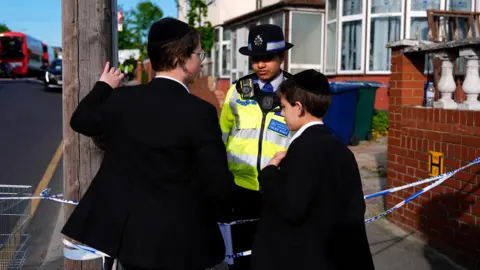 The attack happened in Golders Green, an area of north London with a large Jewish community
bbc.com
The attack happened in Golders Green, an area of north London with a large Jewish community
bbc.com
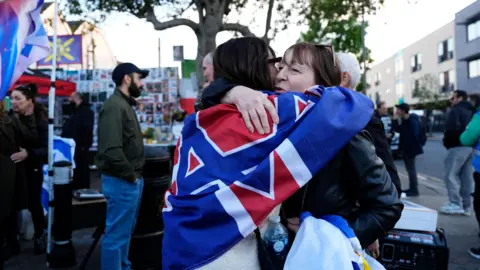 A protest was held in Golders Green after the attack on Wednesday
bbc.com
A protest was held in Golders Green after the attack on Wednesday
bbc.com
 Lambeth town hall. The borough is one of the Green party’s top targets in London for the local council elections. Photograph: Jonathan Harbourne/Alamy
theguardian.com
Lambeth town hall. The borough is one of the Green party’s top targets in London for the local council elections. Photograph: Jonathan Harbourne/Alamy
theguardian.com
Two Jewish men were stabbed in Golders Green on Wednesday, and UK counter-terror police have now treated the attack as terrorism while the national threat level was raised to “severe”, according to the BBC. Within 24 hours, the Metropolitan Police also arrested two Green party local-election candidates in Lambeth on suspicion of stirring up racial hatred online, the Guardian reports. The government’s independent terrorism adviser Jonathan Hall KC described attacks on Jewish people as “the biggest national security emergency” in almost a decade.
The events arrive as London’s Jewish institutions have already been operating under a semi-permanent security posture: armed police near synagogues, controlled entry at schools, and a steady stream of low-cost threats that force expensive responses. The BBC reports the Home Secretary, Shabana Mahmood, rejected the “national emergency” label, arguing the phrase implies extraordinary measures such as suspending parts of democracy, while still promising an “absolute priority” response. The government announced an extra £25 million for patrols and protection around synagogues, schools and community centres—money that buys visible deterrence but also formalises the expectation that ordinary worship and schooling require state-funded guarding.
The Lambeth arrests show how quickly online politics can become a policing matter once campaigns move from activist circles into electoral contests. According to the Guardian, the two women—understood to be Saiqa Ali, standing in Streatham St Leonard’s, and Sabine Mairey, standing in Clapham Town—were arrested on suspicion of an offence under section 19 of the Public Order Act 1986. Screenshots cited by the paper included a post praising “resistance” alongside Hamas imagery and another stating that “ramming a synagogue isn’t antisemitism. It’s revenge.” Lambeth is one of the Green party’s top London targets; the Guardian notes a recent MRP poll suggesting the party could take up to 34% of the vote there, turning candidate selection and vetting into a reputational risk with immediate electoral cost.
In parallel, the security apparatus is treating street violence, arson attempts and online agitation as parts of one problem set. The BBC says a 45-year-old British national—who came to the UK from Somalia as a child—was arrested on suspicion of attempted murder after the Golders Green stabbings; the victims were named locally as Shloime Rand, 34, and Moshe Shine, 76. Prime Minister Keir Starmer told a meeting on Thursday that the attack was not a one-off and demanded a “swift and visible” response from agencies. Community leaders have welcomed extra protection while warning it does not change the wider climate; the Chief Rabbi, Sir Ephraim Mirvis, said the attack showed visibly Jewish people are not safe.
The UK’s terror threat level was last at “severe” in February 2022. This week it rose again, and Lambeth’s ballot papers had to be updated.