
Myanmar junta says Aung San Suu Kyi moved to house arrest
Lawyers and family dispute proof and notice, a controlled image replaces verifiable custody
Images
 State TV broadcast a picture of the Nobel laureate in confinement
bbc.com
State TV broadcast a picture of the Nobel laureate in confinement
bbc.com
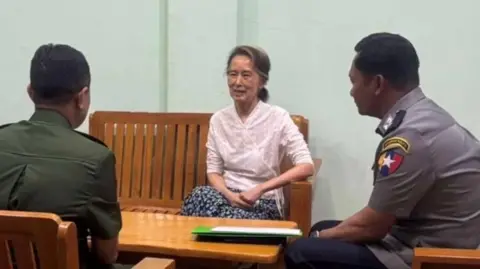 State TV broadcast a picture of the Nobel laureate in confinement
bbc.com
State TV broadcast a picture of the Nobel laureate in confinement
bbc.com
Myanmar’s military says it has moved former leader Aung San Suu Kyi to house arrest, commuting the remainder of her sentence to be served at a “designated residence” after more than three years in detention since the 2021 coup. The announcement, carried by Myanmar state media and reported by the BBC, comes with a single photograph showing the 80-year-old seated beside two uniformed personnel—an image her family disputes.
According to the BBC, junta leader Min Aung Hlaing said Suu Kyi’s remaining term would be served outside prison, but her son Kim Aris said he has no proof she is alive and described the broadcast photo as “meaningless,” claiming it dates from 2022. Suu Kyi’s legal team told Reuters it had received no direct notification of any transfer. The gaps matter because they mirror the system the generals have built since the coup: a state where access to the most basic facts depends on permission, and where even a prisoner’s location becomes classified information.
Suu Kyi was originally sentenced to 33 years on a bundle of charges that allies and rights groups have long described as politically motivated; the term has been reduced several times. Moving her to house arrest does not change the core constraint—she remains cut off from politics and from independent contact—but it does change the optics and the logistics. Prison custody is a visible form of punishment that invites foreign pressure and periodic questions about health and treatment; house arrest is quieter, easier to manage, and historically effective in Myanmar at neutralising prominent opposition figures without creating a public trial stage.
The junta also knows the international script attached to her name. Suu Kyi’s earlier confinement—more than 15 years under previous military rule—turned her into a symbol of non-violent resistance and helped anchor Myanmar’s 2010s reform narrative, culminating in her party’s election victory in 2015 and a Nobel Peace Prize that still travels in headlines. That reputation later fractured when she personally led Myanmar’s defence at the International Court of Justice against genocide accusations linked to the 2017 atrocities against Rohingya Muslims, but her detention remains a barometer foreign governments use when deciding how far to isolate or engage the generals.
The BBC report lands days after earlier sentence reductions, suggesting a pattern: small procedural shifts that produce headlines while the underlying controls—closed courts, sealed prison conditions, and restricted access—stay intact. Even the announced move offers no address, no date of transfer confirmed by counsel, and no independent verification.
Myanmar’s state media says Suu Kyi is no longer in prison. Her lawyers say they were not told where she is.