
Hezbollah steps up drone attacks in south Lebanon
Israel orders 16 villages to evacuate and expands strikes, ceasefire holds on paper while civilians move north
Images
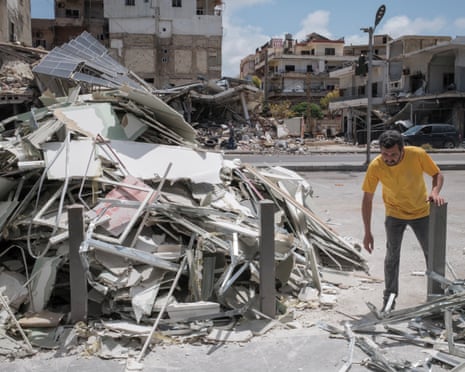 A worker in Tyre, south Lebanon, clears a destroyed shopping building amid fragile ceasefire. Photograph: Marko Đurica/Reuters
theguardian.com
A worker in Tyre, south Lebanon, clears a destroyed shopping building amid fragile ceasefire. Photograph: Marko Đurica/Reuters
theguardian.com
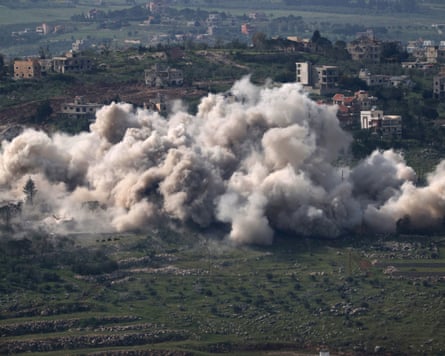 The Israeli army conducts demolition operations in the southern Lebanese village of Taybeh, as seen from the Upper Galilee in northern Israel. Photograph: Atef Safadi/EPA
theguardian.com
The Israeli army conducts demolition operations in the southern Lebanese village of Taybeh, as seen from the Upper Galilee in northern Israel. Photograph: Atef Safadi/EPA
theguardian.com
Hezbollah launched several drones at Israeli soldiers in southern Lebanon on Tuesday, according to the Guardian, as Israel issued new displacement orders covering 16 villages and carried out fresh airstrikes. The Israeli military said interceptor missiles were fired at incoming drones but did not confirm Hezbollah’s claim that soldiers were injured. The exchange follows a Sunday attack that killed one Israeli soldier and wounded six others, a sign that the ceasefire announced on 17 April has not created a stable baseline on the ground.
Since the ceasefire began, Hezbollah has used drones against Israeli positions in south Lebanon almost daily, the Guardian reports, leaning on small fibre‑optic‑guided systems designed to reduce detectable radio emissions. With a reported range of about 15 kilometres, these drones sit awkwardly between tactical harassment and strategic escalation: they can repeatedly test Israel’s air-defence posture without the signature of large rocket salvos. Israel, meanwhile, is pairing strikes with movement control. Displacement orders push civilians north, thinning the area where Hezbollah fighters can hide, but also make it easier for any side to claim military necessity after the fact.
The casualty numbers underline how asymmetric the costs have become. Lebanon’s health ministry says Israeli airstrikes killed 18 people and wounded 88 over the weekend, and that since fighting began on 2 March at least 2,534 people have been killed and 7,863 wounded by Israeli strikes. On the Israeli side, Hezbollah rocket fire has killed two civilians since 2 March, according to the same report. Israel’s prime minister Benjamin Netanyahu has argued that drones and rockets still threaten northern Israel and promised further attacks on Hezbollah infrastructure, adding that the group retains roughly 10% of the missiles it had at the start of the war.
Washington is trying to keep the northern front from colliding with its wider standoff with Tehran. The Guardian notes that US-Iran talks have ground to a halt, with Secretary of State Marco Rubio saying any permanent truce would need to include a deal on Iran’s nuclear programme. Tehran has offered to reopen the Strait of Hormuz in return for the US lifting its blockade — a reminder that the region’s most important shipping lane is being treated as a negotiating instrument, not a neutral corridor. Israeli media reported Netanyahu told Trump Israel needed to respond to Hezbollah attacks to restrain the group, while the US asked Israel to keep any response “calculated and limited”.
The ceasefire itself was reached after the US pressed Israel to negotiate with the Lebanese government, partly to avoid an Israeli invasion that could derail parallel dealings with Iran, the Guardian reports. Since then Israel and Lebanon have held two ambassador-level meetings, including one in the Oval Office with Trump present — unusually formal optics for two states without diplomatic relations.
On Tuesday, as drones crossed the border and villages were told to clear out, Israel’s army was also carrying out demolition operations in the southern Lebanese village of Taybeh. The ceasefire date remains on the calendar; the front line is still moving.