
Islamic State claims Adamawa football pitch attack
BBC reports at least 29 killed in hours-long raid, villagers flee as Nigeria counts prosecutions not protection
Images
 bbc.com
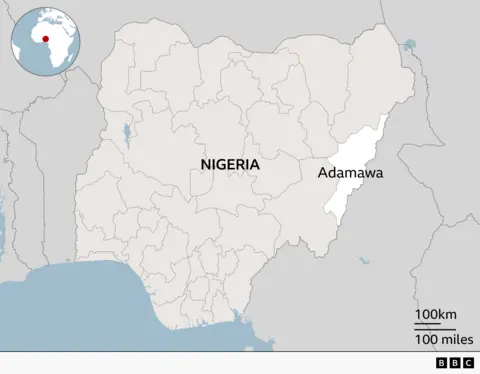 BBC Map of Nigeria showing state boundaries, with Adamawa state highlighted in white in the eastern part of the country along the border with Cameroon. An inset globe locates Nigeria within West Africa, and a scale bar shows distance in kilometres and miles.
bbc.com
BBC Map of Nigeria showing state boundaries, with Adamawa state highlighted in white in the eastern part of the country along the border with Cameroon. An inset globe locates Nigeria within West Africa, and a scale bar shows distance in kilometres and miles.
bbc.com
Gunmen opened fire on a football pitch in Guyaku village in Nigeria’s Adamawa state, killing at least 29 people, the BBC reports, with Islamic State later claiming responsibility. Witness accounts cited by the BBC say the attackers shot at people gathered at the pitch, then burned homes, places of worship and motorcycles during an assault that lasted for hours.
The attack lands in a region where security has become a rotating cast of threats rather than a single insurgency. Adamawa borders Cameroon and has seen repeated violence from both jihadist factions and local criminal gangs, according to the BBC. The state’s response—official visits, promises of intensified operations, and reassurances of restored calm—follows a pattern that rarely changes the household calculation of whether to stay or leave. After an hours-long raid in a small community, the immediate result is not a strategic shift but a wave of private evacuation: families abandoning homes because the next attack could arrive before the next patrol.
Nigeria has lived with jihadist conflict since Boko Haram launched its insurgency in 2009, a campaign that has killed tens of thousands and displaced more than two million people. The violence has also spilled into Niger, Chad and Cameroon, turning borderlands into contested spaces where militants can move and regroup. Abuja has tried mass prosecutions—nearly 400 people were sentenced earlier this month in trials linked to Boko Haram and Islamic State West Africa Province, the BBC notes—but convictions do not automatically translate into control of territory or protection of public gatherings.
With national elections scheduled for January, the federal government faces pressure to show security gains, while communities like Guyaku face the more basic problem of whether a football pitch can remain a public space. The BBC says Adamawa’s governor, Ahmadu Umaru Fintiri, called the attack an “affront to our humanity” and pledged intensified operations.
By the time the governor arrived, the BBC reports, the village atmosphere was still tense, with grief and fear visible and many families already leaving.