
Sanction-linked Russian superyacht crosses Strait of Hormuz
MarineTraffic shows Nord sailing Dubai to Muscat despite blockade, selective passage replaces open shipping lanes with negotiated risk
Images
 The multi-deck luxury boat valued at $500m (£370m) transited the Gulf waterway at the weekend
bbc.com
The multi-deck luxury boat valued at $500m (£370m) transited the Gulf waterway at the weekend
bbc.com
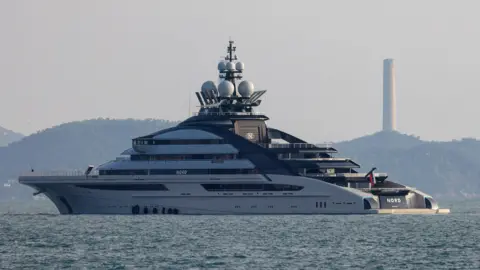 The multi-deck luxury boat valued at $500m (£370m) transited the Gulf waterway at the weekend
bbc.com
The multi-deck luxury boat valued at $500m (£370m) transited the Gulf waterway at the weekend
bbc.com
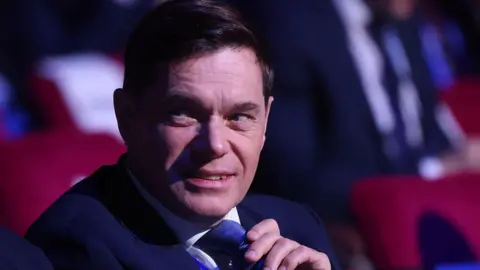 With an estimated net worth of about $37bn (£27bn), Mordashov's is the richest Russian national listed by the US business magazine Forbes
bbc.com
With an estimated net worth of about $37bn (£27bn), Mordashov's is the richest Russian national listed by the US business magazine Forbes
bbc.com
A 142-metre Russian superyacht linked to sanctioned steel billionaire Alexey Mordashov crossed the Strait of Hormuz over the weekend, travelling from Dubai to Muscat as most commercial traffic avoids the waterway, according to the BBC. The transit came as the US and Iran remained deadlocked over reopening the strait, a route that normally carries about one-fifth of global crude oil and liquefied natural gas. MarineTraffic data cited by the BBC showed the Nord arriving at Al Mouj marina in Oman on Sunday morning.
The passage is a small story in tonnage terms and a large one in incentives. When a chokepoint is “effectively closed”, the closure is rarely absolute; it is a pricing regime. Big cargoes stop moving when insurers, charterers, and ports cannot price the risk, while a handful of vessels with unusual backing, opaque ownership, or a high tolerance for uncertainty keep going. In the Nord’s case, the asset sits in the grey zone Western sanctions were meant to eliminate: Mordashov has been targeted by the UK, US, and EU since Russia’s full-scale invasion of Ukraine, yet the yacht has previously avoided seizure in places such as Hong Kong and the Maldives, the BBC notes.
The timing also underlines how quickly geopolitics turns into freight economics. Brent crude rose to around $109 a barrel on Monday amid the standoff, the BBC reports, and maritime traffic through the Gulf channel is now a fraction of pre-war levels. For energy importers, that means the marginal barrel is not just more expensive; it is harder to finance and to deliver on schedule. For exporters and traders, scarcity can be created by paperwork, port access, and risk premia even before physical shortages appear.
Iran has focused diplomatic energy this week on Russia, with President Vladimir Putin hosting Iranian foreign minister Abbas Araghchi in St Petersburg, according to the BBC. Putin described Iranians as “courageously fighting” for sovereignty against American and Israeli pressure, as reported by Russian state media. That political cover matters in a sanctions world where enforcement depends on third countries choosing to cooperate, and where high-value movable assets—ships, cargoes, yachts—can be routed through jurisdictions that prefer discretion to headlines.
The Nord’s onboard pool, submarine and helipad did not change the oil balance. It did demonstrate that even in a blockade, some traffic still moves—just not on terms most of the market is willing to accept.