
Indonesia train collision kills four near Jakarta
KAI says 38 hospitalised after commuter and long-distance trains end up on same track, rescue work exposes thin margins in crowded corridors
Images
 The total number of injuries is still to be confirmed, according to officials
bbc.com
The total number of injuries is still to be confirmed, according to officials
bbc.com
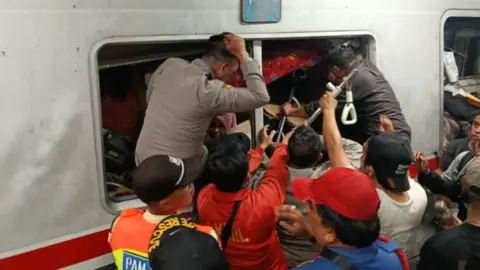 The total number of injuries is still to be confirmed, according to officials
bbc.com
The total number of injuries is still to be confirmed, according to officials
bbc.com
Four people were killed and at least 38 were taken to hospital after two trains collided near Bekasi Timur station about 25km east of Jakarta on Monday, according to the BBC and state railway operator KAI. One train was reportedly stationary on the track when a long-distance service arrived on the same line, leaving carriages crumpled and some passengers trapped. Jakarta’s police chief Asep Edi Suheri said six or seven people were still inside the wreckage during the initial rescue phase, while local footage showed injured passengers on medical trolleys beside the line.
Indonesia’s rail network has expanded quickly around the capital, but the safety envelope has not always grown with it. The BBC notes a “high accident rate” linked to ageing infrastructure and poor maintenance, a combination that turns routine signalling errors into mass-casualty events when trains share congested tracks. KAI’s spokesperson Anne Purba confirmed the initial fatalities and hospitalisations, but the final casualty count was still being verified as rescuers worked through twisted metal—an operational detail that matters because it determines whether the crash is treated as a system failure or a one-off mistake.
The immediate question is how a moving service was allowed onto a track occupied by a stationary commuter train. In dense urban corridors, capacity is often squeezed by running tighter headways rather than adding redundancy—more trains per hour, fewer margins for error. When that bet fails, the costs are paid in emergency response, hospital care, and service disruption, while the underlying maintenance backlog remains politically easier to defer than to fund.
The crash also arrives with a recent precedent. In January 2024, several people were killed and dozens injured in a collision in Cicalengka, with drone footage then showing derailed carriages scattered across a field. Each investigation tends to produce a familiar list—signalling, procedures, oversight—yet the incentives inside a state-run operator can favour restoring timetables and protecting reputation over publishing uncomfortable technical findings.
On Monday, Indonesia’s deputy House speaker Sufmi Dasco Ahmad visited the site and warned the death toll could rise. The trains were still on the same track when they met.