
Friedrich Merz says US humiliated by Iran
German chancellor breaks with Trump’s public line as Hormuz talks stall, Tehran’s ceasefire offer shifts to shipping fees while IMF forecasts deep contraction
Images
 Friedrich Merz during a panel discussion with students in Marsberg, Germany, on Monday. Photograph: Teresa Kroeger/Reuters
theguardian.com
Friedrich Merz during a panel discussion with students in Marsberg, Germany, on Monday. Photograph: Teresa Kroeger/Reuters
theguardian.com
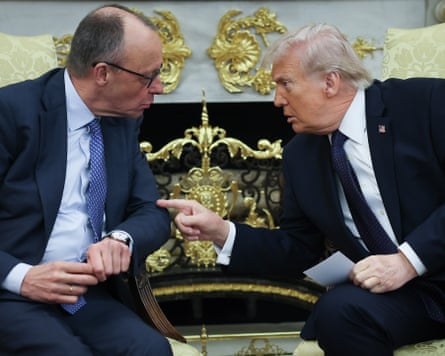 Donald Trump and Friedrich Merz at the White House last month. Photograph: Win McNamee/Getty Images
theguardian.com
Donald Trump and Friedrich Merz at the White House last month. Photograph: Win McNamee/Getty Images
theguardian.com
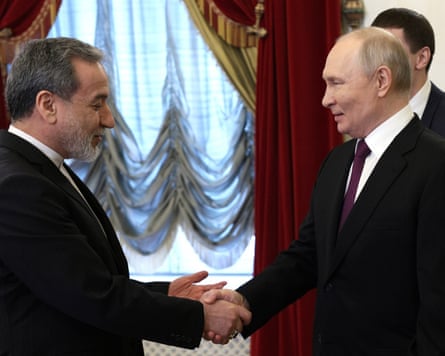 Abbas Araghchi and Vladimir Putin in St Petersburg, Russia, on Monday. Photograph: Anadolu/Getty Images
theguardian.com
Abbas Araghchi and Vladimir Putin in St Petersburg, Russia, on Monday. Photograph: Anadolu/Getty Images
theguardian.com
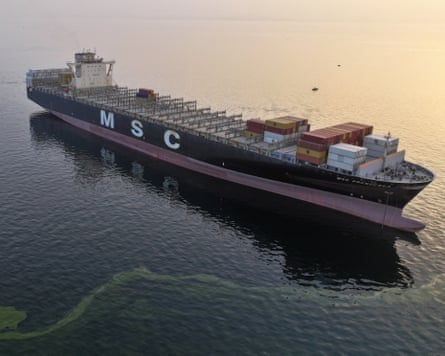 The Panamanian-flagged MSC Francesca was seized by the Islamic Revolutionary Guard Corps in the strait of Hormuz last week. Photograph: Meysam Mirzadeh/Reuters
theguardian.com
The Panamanian-flagged MSC Francesca was seized by the Islamic Revolutionary Guard Corps in the strait of Hormuz last week. Photograph: Meysam Mirzadeh/Reuters
theguardian.com
Friedrich Merz says the US is being “humiliated” by Iran’s leadership, a blunt assessment delivered during a panel discussion with students in Marsberg, Germany, according to The Guardian. The German chancellor argued that Tehran has outmanoeuvred Washington at the negotiating table, days after Donald Trump cancelled a trip by US negotiators to Islamabad for indirect talks with an Iranian delegation. Merz’s remarks land as the Strait of Hormuz remains the practical centre of gravity of the conflict, with shipping disruption now the metric markets and governments watch.
Merz’s criticism cuts against the White House’s public posture. Trump has said the US “have all the cards” and that Iran can come to the US or call if it wants to talk; Merz described a different picture, where Americans fly to Islamabad and leave without results while Iran “negotiates” by not negotiating. The Guardian reports that an earlier round of Islamabad talks two weeks ago—led by vice-president JD Vance—broke up without progress, and that the latest cancellation came just as Iran floated a narrower ceasefire proposal focused on reopening Hormuz.
That “Hormuz first” offer, as described by The Guardian, would postpone the hardest questions—nuclear activity, missiles, sanctions, and broader security arrangements—until later. It also comes with a price tag: Iranian lawmakers are preparing a bill that would require shippers to pay Tehran for “services” involved in transiting the strait, which was free for passage before the war. The UN’s International Maritime Organization has rejected the idea, with secretary general Arsenio Dominguez saying there is no legal basis for taxes or fees on straits used for international navigation.
The economic pressure behind Tehran’s sequencing is increasingly visible. After the breakdown of the Islamabad track, Trump imposed a counter-blockade targeting shipping using Iranian ports, a move that The Guardian says has deepened Iran’s crisis. The International Monetary Fund forecasts a 6.1% contraction in Iran’s GDP this year, with inflation running near 70% year-on-year and food and healthcare rising even faster. The blockade has also trapped Iran’s empty tankers away from port—limiting their use as floating storage—and left the country “very low” on ways to store output, raising the cost of any production slowdown that could damage fields and infrastructure for years.
Diplomatically, Tehran is widening its options even as it narrows the agenda. The Guardian reports Iranian foreign minister Abbas Araghchi met Vladimir Putin in St Petersburg on Monday, while Pakistan has acted as a conduit for the ceasefire proposal to Washington.
Merz’s comments were made in a classroom setting in a small German town. They echoed across a conflict in which the next bargaining chip appears less like a treaty clause than a tollbooth at the mouth of the Gulf.