
Mali defence minister Sadio Camara killed in suicide truck bombing
Coordinated attacks hit Bamako area and northern garrisons, state control claims collide with reports of Russian withdrawal from Kidal
Images
 Camara (L), pictured with the Russian and Malian foreign ministers, is said to have died in a suicide truck bombing
bbc.com
Camara (L), pictured with the Russian and Malian foreign ministers, is said to have died in a suicide truck bombing
bbc.com
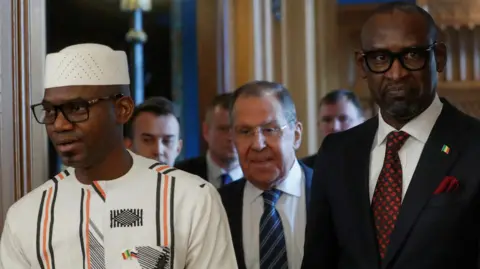 Camara (L), pictured with the Russian and Malian foreign ministers, is said to have died in a suicide truck bombing
bbc.com
Camara (L), pictured with the Russian and Malian foreign ministers, is said to have died in a suicide truck bombing
bbc.com
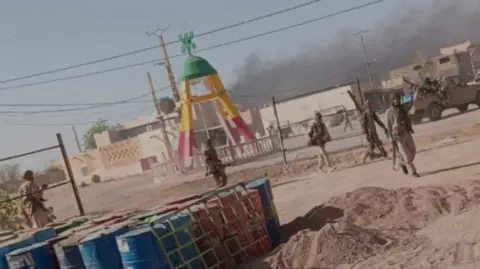 Fighting between the FLA, Malian army and Russian mercenaries continued on Sunday
bbc.com
Fighting between the FLA, Malian army and Russian mercenaries continued on Sunday
bbc.com
Mali’s defence minister Sadio Camara was killed in an apparent suicide truck bombing at his residence near Bamako as militants launched coordinated attacks across several parts of the country. Mali’s state broadcaster ORTM said Camara exchanged fire with attackers and later died of his wounds in hospital, while a government spokesman described a vehicle packed with explosives driven by a suicide attacker. The same wave of violence also targeted the home of junta leader Gen Assimi Goita, who was moved to a safe location, according to the BBC.
The attacks hit a state that has been run by soldiers since the 2020 coup and that has spent years promising to restore territorial control while steadily narrowing political space at home. The scale of the operation—fighting reported in Kati, Gao, Kidal, Sevare and Mopti—suggests planners were confident the army could be stretched thin, even around the capital. Ulf Laessing of the Konrad Adenauer Foundation called it the largest coordinated jihadist assault in years, a reminder that insurgent groups do not need to “hold” cities to impose costs; they only need to make movement, trade and administration unreliable.
In the north, Tuareg separatists from the Azawad Liberation Front (FLA) said they had taken Kidal and that Russian forces aligned with Mali’s military were withdrawing after clashes. The FLA also claimed an agreement with Russia’s Africa Corps to ensure a secure withdrawal, presenting Kidal as “free” again—language aimed as much at recruitment and fundraising as at cartography. Mali’s army has not confirmed the withdrawal or the loss of Kidal, and ORTM insisted the situation was “completely under control” and damage was limited, even as it acknowledged injuries among civilians and soldiers.
The Russian role has become a second front inside Mali’s security problem: hired muscle that can help seize a town, but cannot make a state function. When foreign contractors are paid for presence and optics, the local chain of command still has to supply intelligence, logistics and legitimacy—things that cannot be flown in. If Russian units do pull back from Kidal, the immediate question is not only who occupies the city, but who pays to keep roads open, salaries flowing and garrisons supplied once the headlines move on.
Camara’s home reportedly collapsed in the blast and a nearby mosque was destroyed, with worshippers among the dead, according to the BBC’s account of local and French media reporting. ORTM’s reassurance that the situation was under control arrived only after Mali confirmed its defence minister had been killed at home.