
Shooting disrupts White House Correspondents’ Association dinner
Secret Service rushes Trump from Washington Hilton, black-tie media ritual meets checkpoint reality
Images
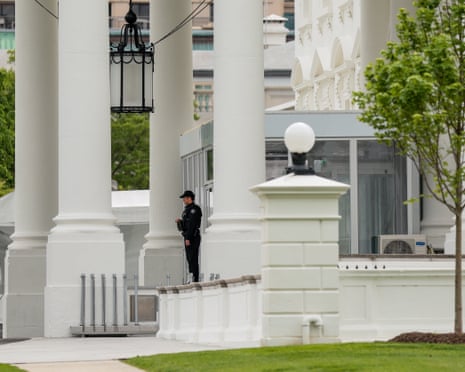 An officer stands guard outside the White House in Washington DC on 26 April, a day after a shooting incident occurred at the Washington Hilton hotel. Photograph: Kylie Cooper/Reuters
theguardian.com
An officer stands guard outside the White House in Washington DC on 26 April, a day after a shooting incident occurred at the Washington Hilton hotel. Photograph: Kylie Cooper/Reuters
theguardian.com
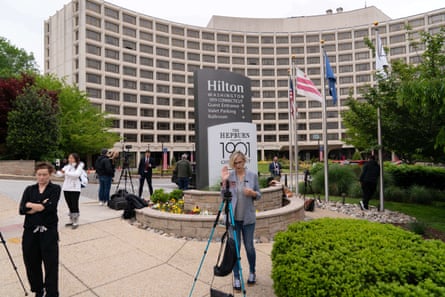 Journalists gather outside of the Washington Hilton hotel on 26 April, the day after a gunman tried to storm into the hotel’s ballroom during the White House correspondents’ dinner. Photograph: José Luis Magaña/AP
theguardian.com
Journalists gather outside of the Washington Hilton hotel on 26 April, the day after a gunman tried to storm into the hotel’s ballroom during the White House correspondents’ dinner. Photograph: José Luis Magaña/AP
theguardian.com
A gunman opened fire at the Washington Hilton on 25 April during the White House Correspondents’ Association dinner, sending guests under tables and prompting Secret Service agents to rush Donald and Melania Trump out of the ballroom. The Guardian reports that the suspect targeted a Secret Service agent at a security checkpoint before being tackled and arrested. Officials said the attacker appeared to be aiming at senior administration figures, potentially including the president.
The incident lands in an awkward place for an event designed to project normalcy: a black-tie media gala that depends on the same security perimeter as a presidential appearance, but is staged in a hotel built for flow, not for hard lockdown. The Washington Hilton is a familiar venue for political Washington—and an infamous one, as the site where Ronald Reagan was shot in 1981. A checkpoint is a choke point, and in a hotel it is also a public interface: staff, contractors, and guests all arrive through the same corridors, creating the kind of high-throughput screening environment where a single failure can cascade.
The political context is also a practical one. The Guardian notes that threats to members of Congress are at record highs, and some lawmakers now hire private security. That is a market response to an institutional reality: federal protection is rationed, and risk is unevenly distributed. A president is protected by a large apparatus; everyone else in the room is protected by the residual capacity of that apparatus, and by the assumption that the event’s symbolism will deter attacks. When that assumption fails, the public spectacle becomes part of the operational problem—crowds freezing, guests hiding, and the evacuation itself turning into a security variable.
The episode will likely harden the already-expanding security footprint around politics and media in Washington. More credential checks, tighter perimeters, and fewer open-access venues raise costs and narrow who can attend—an effect that tends to be invisible until it becomes a new baseline. The people who can absorb those costs are the institutions that already dominate the room.
The White House Correspondents’ Association dinner continued to be treated as a civic ritual. It ended with the president and first lady leaving through a security exit at the same hotel where a president was shot 45 years earlier.