
Fossil beaks suggest giant octopus predators in Cretaceous seas
Science paper links 27 Pacific finds to Nanaimoteuthis species, apex-hunter role inferred from extreme beak wear
Images
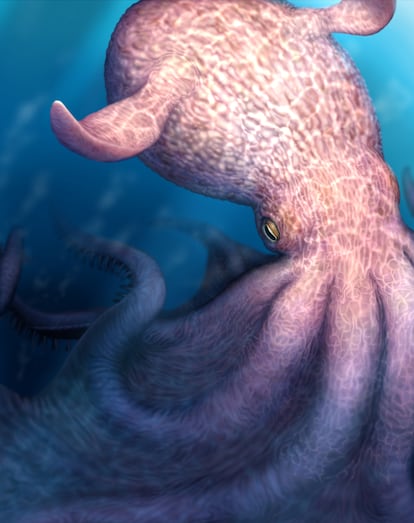 Reconstruction of what the gigantic octopus might have looked like.Yohei Utsuki
english.elpais.com
Reconstruction of what the gigantic octopus might have looked like.Yohei Utsuki
english.elpais.com
Researchers have identified fossil beaks from two extinct cephalopods that suggest giant octopus-like predators lived in the Late Cretaceous and may have reached lengths comparable to today’s largest squids. According to El País, the team led by Shin Ikegami of Hokkaido University analysed 27 beaks recovered from marine sediments in Japan and around Vancouver Island and described two species, Nanaimoteuthis jeletzkyi and Nanaimoteuthis haggarti, in a study published in Science.
Octopuses rarely leave a clear fossil trail because they lack hard skeletons and shells; most of their bodies decay without trace. Beaks—dense, chitinous jaw structures—are one of the few durable parts, and they can be used to infer body size by comparing them with modern cephalopods. The beaks in this study were not just large; they also showed heavy edge wear consistent with repeated biting on hard prey such as crustaceans, molluscs and fish. In adult specimens, wear removed up to 10% of beak length—more than reported for modern cephalopods—implying sustained predatory activity over the animals’ lifetimes.
The paper’s headline claim is size: N. haggarti is estimated at roughly 7 to 19 metres in total length, which would place it among the largest invertebrates known. That matters because reconstructions of Cretaceous marine food webs are typically vertebrate-centric. Mosasaurs and plesiosaurs dominate popular and scientific narratives of apex predation in warm, shallow seas, while invertebrates are often cast as prey that responded by thickening shells. A large, active cephalopod predator would complicate that picture: it implies competition for similar prey and ecological space, and it suggests that “top of the chain” roles were not reserved for reptiles and sharks.
The study also points to behavioural implications. The beak wear was asymmetric—more worn on the right edge than the left—hinting at lateralisation, a preference for using one side. In living animals, lateralisation is associated with specialised neural processing and more complex behaviour. Modern octopuses show lateralised tendencies and are known for problem-solving and learning; the fossil pattern does not prove intelligence, but it suggests that the neurological traits behind consistent side-bias could be deep-rooted.
The evidence remains indirect because the animals’ soft bodies are missing, and size estimates depend on scaling relationships that are better established for some cephalopods than others. Still, the beaks are physical, measurable structures, and the wear pattern is difficult to explain as a coincidence.
Twenty-seven beaks pulled from sediments on two sides of the Pacific are now doing the work that bones usually do. They point to a Cretaceous ocean where the biggest predator may not have had a backbone at all.