
Chinese tuna vessel linked to three onboard deaths
Crew testimony describes 16-hour shifts and inadequate food and medical care, EU and UK seafood supply chains rely on distant enforcement
Images
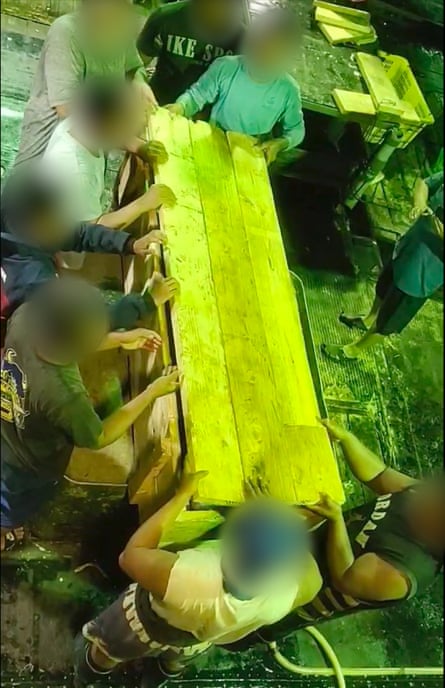
 When Isko, a fisher on the Tia Xiang 5 died, fellow crew members built a makeshift coffin from wooden pallets. Photograph: supplied
theguardian.com
When Isko, a fisher on the Tia Xiang 5 died, fellow crew members built a makeshift coffin from wooden pallets. Photograph: supplied
theguardian.com
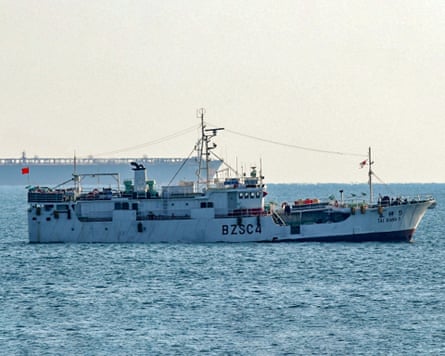 Tai Xiang 5, a Chinese vessel belonging to Shandong Zhonglu Ocecanic Fisheries. Photograph: supplied
theguardian.com
Tai Xiang 5, a Chinese vessel belonging to Shandong Zhonglu Ocecanic Fisheries. Photograph: supplied
theguardian.com
 Abdul, who says after the voyage he was hospitalised and treated for lymphatic disease. Photograph: supplied
theguardian.com
Abdul, who says after the voyage he was hospitalised and treated for lymphatic disease. Photograph: supplied
theguardian.com
 Three fishers died during one voyage on the Tai Xiang 5, crew members claim. Photograph: supplied
theguardian.com
Three fishers died during one voyage on the Tai Xiang 5, crew members claim. Photograph: supplied
theguardian.com
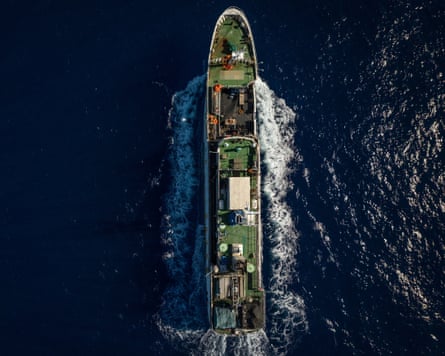 Because of the time it takes to set and retrieve lines, fishers on tuna longline vessels are at particular risk of excessive working hours. Photograph: Environmental Justice Foundation
theguardian.com
Because of the time it takes to set and retrieve lines, fishers on tuna longline vessels are at particular risk of excessive working hours. Photograph: Environmental Justice Foundation
theguardian.com
Three crew members died on a Chinese longline tuna vessel in the Indian Ocean after months of illness and alleged mistreatment, according to testimony collected by the Environmental Justice Foundation and reported by the Guardian.
The ship, Tai Xiang 5, is owned by Shandong Zhonglu Oceanic Fisheries, which the Guardian describes as a large state-owned fishing company. Crew members interviewed by EJF said they worked 16-hour days for about 4.6 million Indonesian rupiah a month, roughly £198, and received little medical care as multiple men developed swollen limbs, weakness and shortness of breath.
The accounts depict a workplace where the cost of stopping is pushed onto the lowest-paid people onboard. Abdul, an Indonesian crew member, said he was told he was “weak” and “overreacting” when he first fell ill and felt compelled to keep working even when he could barely stand. Another crew member said a Filipino fisher, Isko, was ostracised after declaring himself unfit for work and was forced to sleep on deck under a tarpaulin. He died days later, with the ship not returning to port.
EJF says the symptoms described are consistent with beriberi, a disease caused by vitamin deficiency, which has been documented among migrant fishers when diets are poor and monotonous. Crew members told investigators they were fed bait fish that was not fresh, with few vegetables, and that drinking water distilled from seawater could become “too salty” when equipment failed or appear “yellow” or “dirty”. In that setting, illness is not a random hazard but a predictable output of provisioning decisions made to maximise time at sea.
The story also illustrates how distance and paperwork can shield responsibility. The vessel operates far from the markets where its catch is sold, while ownership sits with a state-linked company and labour is recruited across borders. When deaths occur mid-voyage, the immediate decision-makers are the captain and officers, but the conditions described—food quality, water systems, medical protocols, rest rules—are set by policies and budgets that rarely appear on a supermarket label.
The Guardian reports that a video obtained by EJF shows a dead man lying in a corridor as other crew continue fishing below deck. Fellow crew members built a makeshift coffin from wooden pallets.
Three men reportedly died on the same voyage, and the ship continued operating as the remaining crew worked their shifts.