
Two trains collide head-on north of Copenhagen
Investigators probe signalling and safety systems on regional line, 38 passengers depend on procedures when automation is missing
Images
 The trains collided head-on between the towns of Hillerød and Kagerup about 40km (25 miles) north-west of the capital
bbc.com
The trains collided head-on between the towns of Hillerød and Kagerup about 40km (25 miles) north-west of the capital
bbc.com
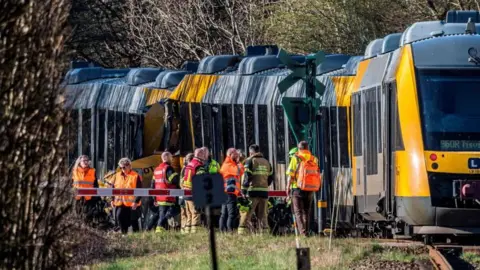 The trains collided head-on between the towns of Hillerød and Kagerup about 40km (25 miles) north-west of the capital
bbc.com
The trains collided head-on between the towns of Hillerød and Kagerup about 40km (25 miles) north-west of the capital
bbc.com
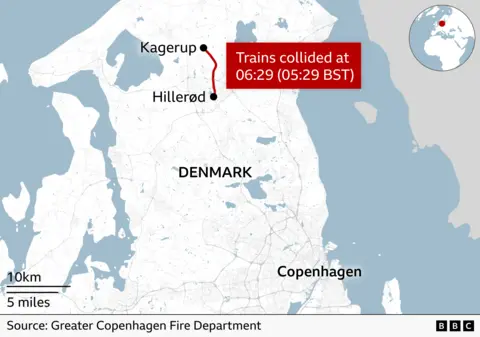 Alt text: Map of northern Denmark showing the location of a train collision between Kagerup and Hillerød. A red line marks the railway section where the trains collided at 06:29 local time (05:29 BST). Copenhagen is labelled to the southeast. An inset globe highlights Denmark’s location in northern Europe. Scale bar shows 10 km and 5 miles. Source: Greater Copenhagen Fire Department, BBC.
bbc.com
Alt text: Map of northern Denmark showing the location of a train collision between Kagerup and Hillerød. A red line marks the railway section where the trains collided at 06:29 local time (05:29 BST). Copenhagen is labelled to the southeast. An inset globe highlights Denmark’s location in northern Europe. Scale bar shows 10 km and 5 miles. Source: Greater Copenhagen Fire Department, BBC.
bbc.com
 Police said the trains had been travelling fast but exact speeds were not yet known. Photograph: Steven Knap/EPA
theguardian.com
Police said the trains had been travelling fast but exact speeds were not yet known. Photograph: Steven Knap/EPA
theguardian.com
Two local trains collided head-on north-west of Copenhagen on Thursday morning, leaving five people critically injured and at least 12 more with minor injuries, according to police and medical officials cited by the BBC and the Guardian. The crash happened around 06:29 local time on a line between Hillerød and Kagerup in North Zealand, with 38 passengers on board. Rescue services transported the injured by ambulance and helicopter, and Denmark’s Accident Investigation Board arrived at the scene to begin a technical investigation.
The immediate question is how two trains ended up facing each other on the same track segment. Investigators have not said whether signalling failed, whether a switch was set incorrectly, or whether human error played a role, but police told reporters it was “far too early” to draw conclusions. Still, the scenario described by one rail expert to the BBC — a driver passing a stop signal and entering the wrong line — points to a familiar vulnerability on lightly upgraded regional routes: safety depends on a chain of procedures and attention, rather than on an automated system that physically prevents a train from entering an occupied block.
That distinction matters because Denmark’s rail reputation rests heavily on the reliability of its core corridors, while many commuter and rural lines operate with older infrastructure and fewer layers of automatic protection. If the Gribskov line lacks modern automatic train protection, as the BBC report suggests, the cost of upgrading has effectively been traded for a managed level of residual risk. When that risk materialises, the bill is paid in emergency mobilisation, hospital capacity, disrupted commuting for “residents, workers and students” in the area, and the political pressure that follows any incident involving public transport.
The Guardian reports that police said the trains were travelling fast, with exact speeds still unknown, and that passengers were thrown around as the collision sent glass flying through the carriages. A crisis centre was set up in Hillerød for passengers and relatives. Officials will now have to explain not only what failed at 06:29, but also why the system allowed a single failure — whether mechanical, procedural, or human — to escalate into a head-on collision.
Photographs from the scene showed two yellow and grey trains in a wooded area, both with heavy damage to the front, stopped nose-to-nose on the same line.