
El Salvador opens mass trial for 486 alleged MS-13 members
Prosecutors cite 47000 crimes under Bukele emergency powers, due process concerns collide with falling homicide rate
Images
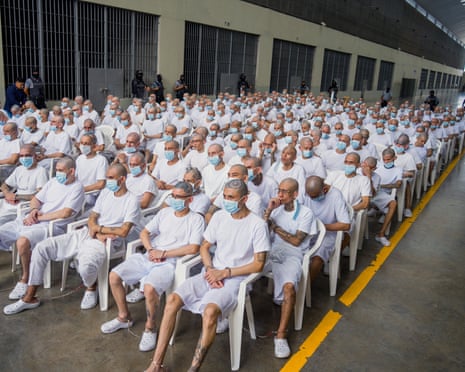 Around 490 alleged members of the powerful Central American gang Mara Salvatrucha (MS-13), including its leaders, have gone on trial collectively in El Salvador, the Attorney General's office and courts said on 20 April. Photograph: El Salvador Attorney General's Office/AFP/Getty Images
theguardian.com
Around 490 alleged members of the powerful Central American gang Mara Salvatrucha (MS-13), including its leaders, have gone on trial collectively in El Salvador, the Attorney General's office and courts said on 20 April. Photograph: El Salvador Attorney General's Office/AFP/Getty Images
theguardian.com
El Salvador puts 486 alleged MS-13 members on trial together, prosecutors cite 47000 crimes under emergency powers, mass convictions become a governing tool
A Salvadoran court on Tuesday opened a single collective trial for 486 alleged members of the MS-13 gang, including purported leaders, in one of the largest proceedings yet under President Nayib Bukele’s state-of-emergency crackdown. Reuters reporting via The Guardian says prosecutors are tying the defendants to more than 47,000 crimes committed between 2012 and 2022, ranging from homicide and femicide to extortion and arms trafficking.
The trial is possible because Congress passed a decree allowing mass prosecutions after Bukele’s emergency regime began in 2022 and was repeatedly renewed. Under that framework, security forces have detained more than 91,500 people, and the government argues the measures drove the homicide rate down to 1.3 per 100,000 people last year, from 7.8 in 2022.
The scale is the point. Bundling hundreds of defendants into one case changes the practical meaning of “trial”: evidence is presented as a narrative of organisational guilt—autopsies, ballistics and witness testimony—rather than as a series of individualized disputes about who did what, when, and under what corroboration. Human rights groups have warned that collective proceedings restrict access to legal counsel and weaken the ability of defendants to challenge evidence tailored to their specific charges.
The Inter-American Commission on Human Rights reiterated those concerns on Tuesday, calling for an end to the prolonged emergency approach. The commission said the regime suspends the right to a legal defense and the inviolability of communications, while extending administrative detention timelines—procedural changes that make it easier to hold large numbers of suspects while the state assembles cases at industrial scale.
The defendants are being held across five prisons, including Cecot, the maximum-security facility opened in 2023 that has become the emblem of Bukele’s policy. The government’s pitch is straightforward: gang rule was a public-order failure, and the state is now selling certainty—fewer murders, fewer extortions—at the price of narrower process.
That bargain also creates its own constituency. A system built around mass detention and mass trials depends on continued throughput: police units rewarded for arrests, prosecutors rewarded for volume, and politicians rewarded for visible “results” that can be counted in prison populations and falling homicide rates. Once the machinery exists, the temptation is to keep it running, because stopping would mean explaining which detainees should be released and why.
Prosecutors are seeking maximum sentences for each crime, and Reuters notes a single defendant could face up to 245 years if convicted on multiple counts. Among those charged are alleged long-standing leaders who participated in the 2012–2014 gang truce under former president Mauricio Funes, a reminder that El Salvador’s relationship with MS-13 has included negotiation as well as repression.
On Tuesday the court began hearing a case in which nearly 500 people are treated as one docket entry. The prison they are held in was built to be photographed from above.