
Gunman opens fire at Mexico’s Teotihuacán pyramids
Canadian tourist killed at Unesco site near Mexico City as World Cup preparations sharpen security scrutiny
Images
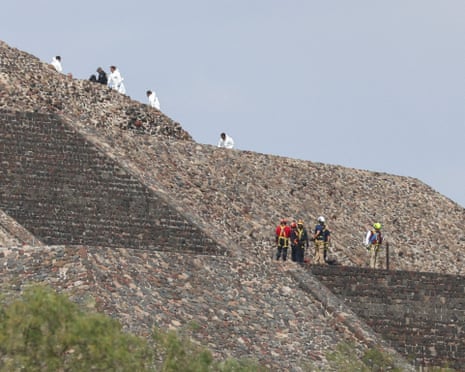 Mexican authorities work at the scene where a man shot dead a Canadian woman and injured several others before killing himself. Photograph: Luis Cortés/Reuters
theguardian.com
Mexican authorities work at the scene where a man shot dead a Canadian woman and injured several others before killing himself. Photograph: Luis Cortés/Reuters
theguardian.com
A gunman opened fire at Mexico’s Teotihuacán archaeological complex near Mexico City on Monday lunchtime, killing a Canadian tourist and wounding at least four other people. The attack, which Mexican authorities said ended when the shooter took his own life, unfolded around the Pyramid of the Moon and was recorded in mobile-phone videos shared by visitors. Teotihuacán, a Unesco world heritage site that draws close to two million tourists a year, is one of the country’s most visited landmarks.
According to The Guardian, a witness told the newspaper La Jornada she heard more than 20 shots, first sporadic and then in rapid succession, and believed the attacker used a handgun. Mexican authorities said four people — citizens of Colombia, Russia and Canada — suffered gunshot wounds, and a fifth person broke a bone after apparently falling from the 43-metre pyramid during the panic. Mexico’s foreign ministry said it was in contact with the Canadian embassy and other embassies representing those affected.
The shooting lands as Mexico prepares to co-host the football World Cup in June and to stage 13 matches, including the tournament’s opening game. Big events concentrate visitors and security resources in predictable places; they also concentrate reputational risk. A single incident at a globally recognisable site can do more damage to tourism demand than a week of violence in places foreign visitors rarely see, because the footage travels and the location is instantly legible.
President Claudia Sheinbaum expressed “deep pain” and called for a thorough investigation, while the British embassy urged UK citizens in the area to follow local instructions. The episode follows a spike of attention on Mexico’s security after February’s killing of a major cartel figure known as “El Mencho” near Guadalajara and the coordinated cartel attacks that reportedly followed. Authorities said that wave was quickly contained, but the Teotihuacán shooting shows how quickly insecurity can surface outside the usual geography of cartel conflict.
At Teotihuacán, the immediate questions are operational rather than rhetorical: how a firearm reached the pyramid area, how quickly armed response arrived, and what changes will be made before the next peak tourist weekend. The site’s visitor flow is managed through ticketing, entrances and fixed routes; those same choke points can either deter weapons or turn into bottlenecks when people run.
A Canadian woman was killed at the Pyramid of the Moon, and another visitor was injured badly enough to break a bone while trying to get away.