
Japan issues tsunami alert after strong offshore quake
7.4 magnitude reported off Sanriku coast with possible three-metre waves, high-speed rail suspensions show how quickly daily life pauses
Images
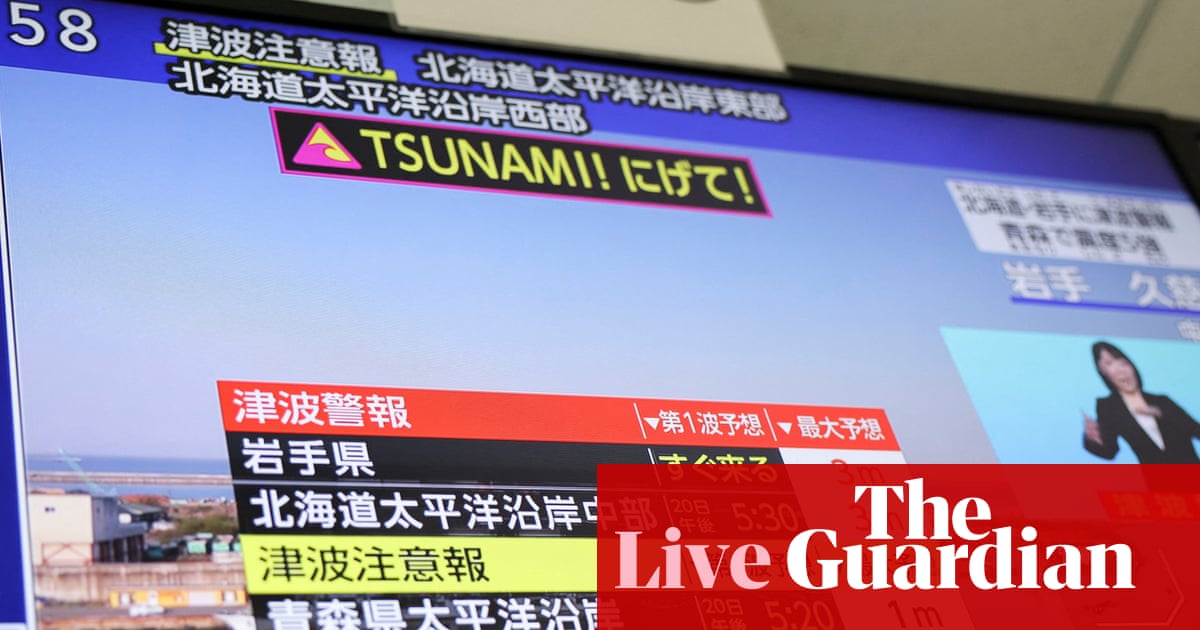 Japan tsunami alert issued following powerful earthquake off northern coast – follow latest
theguardian.com
Japan tsunami alert issued following powerful earthquake off northern coast – follow latest
theguardian.com
A magnitude 7.4 earthquake struck off Japan’s northern Sanriku coast at about 4:53pm local time on Monday, prompting the Japan Meteorological Agency (JMA) to issue tsunami alerts for parts of the northeast, according to the Guardian’s live coverage. Japanese public broadcaster NHK reported that waves of up to three metres could reach coastal areas.
The quake’s preliminary parameters—shallow depth of roughly 10km and an offshore epicentre—are the combination that forces authorities to act on worst-case models before they have tide-gauge confirmation. A tsunami warning is not a prediction of what will happen so much as a decision about what cannot be risked: coastal residents are told to evacuate because the cost of a false alarm is small compared with the cost of being late. That logic has been institutionalised in Japan since 2011, when the Tōhoku earthquake and tsunami exposed how quickly “unlikely” scenarios become operational realities.
The immediate economic effects are visible even before any wave arrives. NHK said high-speed rail services between Tokyo and Aomori were suspended, a reminder that modern transport networks are designed around tight tolerances: one seismic event can halt long-distance mobility and strand commuters and freight in minutes. For coastal towns, the disruption is more than logistical. Evacuation orders shift people out of homes and businesses, and ports and fisheries often stop operations as a precaution, temporarily cutting income in communities that already live with seasonal volatility.
Japan’s geography makes this a recurring governance problem. The country sits on multiple tectonic boundaries and experiences a disproportionate share of the world’s strongest earthquakes; the state therefore runs a permanent warning-and-evacuation apparatus with public drills, sirens, and real-time messaging. That system reduces fatalities, but it also creates a constant trade-off between credibility and caution: if warnings are frequent and waves are small, compliance can erode; if officials wait for confirmation, the warning arrives too late.
On Monday, the JMA’s initial bulletin and NHK’s reporting pushed the same concrete instruction: people near the sea should move to higher ground. The rest of the country, meanwhile, was left watching transport cancellations and scrolling for wave measurements.
The quake was reported at around 10km depth off Iwate, and the first public estimate of possible tsunami height was three metres.