
Fire destroys 1000 stilt homes in Sabah
Coastal Sandakan water village leaves about 9000 residents displaced, narrow access and low tide block firefighting
Images
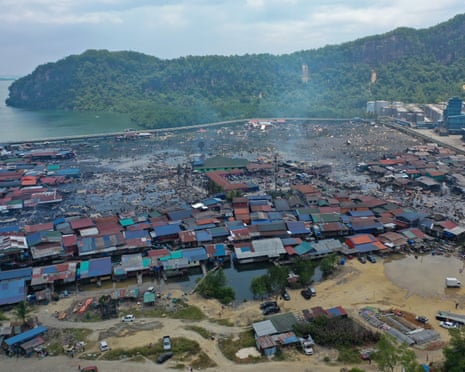 Thousands have been displaced after a fire in a coastal village in the northern Borneo state of Sabah, Malaysian authorities said on Sunday. Photograph: Xinhua/Shutterstock
theguardian.com
Thousands have been displaced after a fire in a coastal village in the northern Borneo state of Sabah, Malaysian authorities said on Sunday. Photograph: Xinhua/Shutterstock
theguardian.com
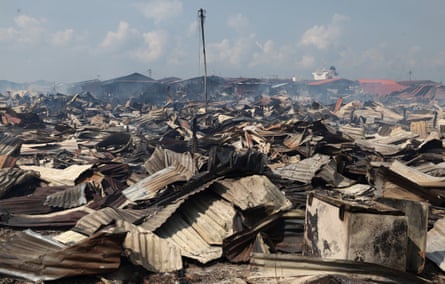 Ruins of houses following a fire that destroyed about 1,000 homes in a coastal village in Sandakan, Malaysia, 19 April 2026. Photograph: Reuters
theguardian.com
Ruins of houses following a fire that destroyed about 1,000 homes in a coastal village in Sandakan, Malaysia, 19 April 2026. Photograph: Reuters
theguardian.com
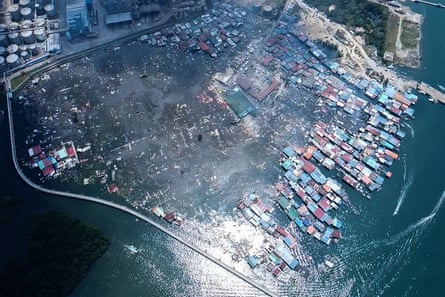 An aerial view of Kampung Bahagia water village after a fire in Sandakan on Malaysia's Borneo island. Photograph: Malaysia’s Sandakan Fire and Rescue Department/AFP/Getty Images
theguardian.com
An aerial view of Kampung Bahagia water village after a fire in Sandakan on Malaysia's Borneo island. Photograph: Malaysia’s Sandakan Fire and Rescue Department/AFP/Getty Images
theguardian.com
A fire that began around 1.30am on Sunday tore through Kampung Bahagia, a coastal “water village” outside Sandakan in Malaysia’s Sabah state, destroying roughly 1,000 stilt homes and leaving thousands without shelter.
Sabah’s fire and rescue department said the blaze consumed an estimated 10 acres of densely packed, largely wooden structures built over water and that the settlement was “100% burnt”. Police in Sandakan put the number of affected residents at 9,007, according to The Guardian’s report citing local authorities. No deaths or injuries were reported.
The mechanics of the disaster were as revealing as the scale. Fire engines could not reach the burning homes because the settlement’s access routes are narrow and improvised; firefighters were forced to work around the built environment rather than through it. Low tide limited access to open water for pumping, while strong winds pushed flames across contiguous rooftops. In other words, the village’s cheapest construction materials and tight spacing—features that make housing possible for people with few alternatives—also turned one ignition point into a neighbourhood-wide loss.
Kampung Bahagia is not a formal housing estate but an informal settlement that has grown at the edge of a port city, home to some of Malaysia’s poorest residents. Such communities often include indigenous families and people without clear citizenship status, groups that can struggle to access formal property rights, insurance, or bank credit. When housing is built outside the permitting system, it also tends to sit outside municipal investment: roads wide enough for emergency vehicles, hydrants, and basic fire breaks are rarely retrofitted into places that are politically marginal and physically hard to service.
The immediate response now shifts from extinguishing flames to managing displacement. Prime minister Anwar Ibrahim said the federal government was coordinating with Sabah authorities to provide assistance and temporary accommodation “as soon as possible”. That promise typically means public buildings, tents, or rented facilities—solutions that stabilise a crisis but do not replace lost assets. For residents whose homes doubled as workplaces and storage, the fire also wipes out tools, inventory, and cash, creating a second wave of hardship that is harder to photograph and easier to underfund.
Sabah has long balanced rapid urban growth, migration within Borneo and across maritime borders, and uneven public services between formal towns and peripheral settlements. Fires in stilt-house communities are a recurring risk across Southeast Asia, but each incident tests the same question: whether authorities treat informal neighbourhoods as temporary anomalies or as permanent parts of the city worth building infrastructure around.
By Sunday afternoon, the fire department said there was “no more danger”. In Sandakan, thousands of residents were left standing on the shoreline looking at where their homes had been.