
US navy seizes Iranian-flagged container ship
USS Spruance disables TOUSKA near Strait of Hormuz after it ignores stop order, blockade enforcement shifts from paperwork to gunfire
Images
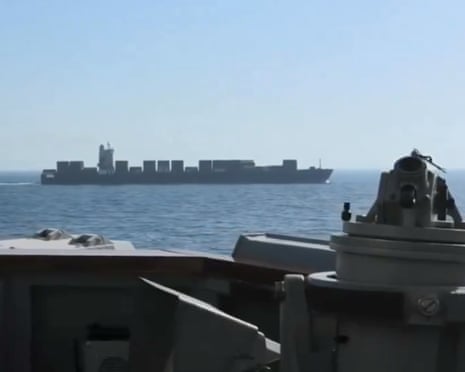 US forces operating in the Arabian Sea enforced naval blockade measures against an Iranian-flagged cargo vessel attempting to sail toward an Iranian port, on 19 April. Photograph: U.S. Central Command
theguardian.com
US forces operating in the Arabian Sea enforced naval blockade measures against an Iranian-flagged cargo vessel attempting to sail toward an Iranian port, on 19 April. Photograph: U.S. Central Command
theguardian.com
 US navy ship fires on vessel trying to get past blockade
theguardian.com
US navy ship fires on vessel trying to get past blockade
theguardian.com
US forces have seized an Iranian-flagged container ship near the Strait of Hormuz after firing on it to stop it, according to a statement by President Donald Trump and footage released by the Pentagon. Trump said the guided-missile destroyer USS Spruance ordered the vessel, identified as the TOUSKA, to halt in the Gulf of Oman; when it did not, the ship was disabled by fire that “blew a hole in the engine room” before US marines took custody.
The incident lands inside a shipping crisis that has already been driven as much by paperwork and insurance as by missiles. In recent days, US announcements of a naval “blockade” of Iranian ports have left hundreds of vessels waiting in the Persian Gulf and Gulf of Oman, with shipowners and insurers trying to price the risk of being boarded, delayed or misidentified. A kinetic interdiction changes that calculation: it turns ambiguous compliance into a physical test of whether a captain will obey US orders at sea, and whether the US is prepared to damage a commercial ship to enforce them.
Trump said the TOUSKA is under US Treasury sanctions for prior “illegal activity”. The Guardian reports that tracking data showed the ship had sailed from Port Klang in Malaysia and was attempting to move toward an Iranian port when it was intercepted. Video released by the US defense department includes radio warnings to the crew to vacate the engine room and that the vessel would be subjected to disabling fire if it failed to stop.
Iran’s official response was not included in the US accounts, but the action comes as a time-limited ceasefire between Washington and Tehran nears expiry and as both sides accuse the other of violating its terms. In this environment, enforcement actions at sea do double duty: they are presented as sanctions implementation while also serving as leverage ahead of talks, with commercial shipping acting as the pressure point.
The ship is more than 900 feet long, according to MarineTraffic data cited by the Guardian. It was stopped in the Gulf of Oman, the approach lane to Hormuz where small decisions—whether to answer a radio call, whether to slow down—now carry strategic consequences.
On Sunday, the USS Spruance fired into a merchant vessel’s engine room and then boarded it.