
Humanoid robots beat half-marathon world record in Beijing
Honor-built runner clocks 50:26 in parallel race, machines still need handlers after crashing at finish
Images
 A robot runs in the second Beijing E-Town half marathon and humanoid half marathon in Beijing. Photograph: Pedro Pardo/AFP/Getty Images
theguardian.com
A robot runs in the second Beijing E-Town half marathon and humanoid half marathon in Beijing. Photograph: Pedro Pardo/AFP/Getty Images
theguardian.com
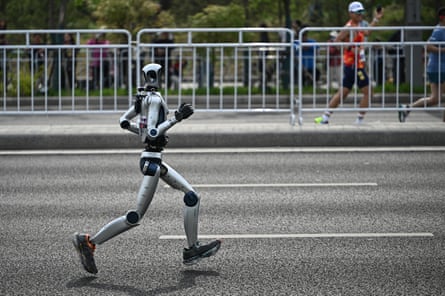 A robot heads round the course in Beijing. Photograph: Pedro Pardo/AFP/Getty Images
theguardian.com
A robot heads round the course in Beijing. Photograph: Pedro Pardo/AFP/Getty Images
theguardian.com
Humanoid robots line up at the starting gate in Beijing’s E‑Town half-marathon, and this time they do not wobble for the cameras. According to Reuters, more than 100 Chinese-made robots ran in parallel lanes alongside human athletes on Sunday, a sharp change from last year’s debut edition where many machines struggled to move and most failed to finish.
The headline moment came at the front of the robot field. Reuters reports the winning humanoid, developed by Honor, crossed the line in 50 minutes and 26 seconds—faster than the human half-marathon world record set last month by Uganda’s Jacob Kiplimo in Lisbon. The robot still needed help after clipping a railing near the finish, but it completed the course and secured a time that would be extraordinary even for elite runners.
The spectacle is not just about sport. China has been using public demonstrations—from the CCTV Spring Festival gala to industrial expos—to signal that humanoid robots are moving from lab prototypes toward physical competence. Marathon running is a blunt test: balance, endurance, real-time correction on uneven surfaces, and the ability to keep functioning after minor impacts. A machine that can hold pace for 21 kilometres is also a machine that can plausibly carry tools, climb stairs, patrol a perimeter, or operate in environments where a wheeled platform is useless.
The immediate economic question is not whether robots can win races, but whether they can do paid work without a safety crew. Reuters notes that “economically valuable applications” are still in trial phases, which is another way of saying the unit economics are not settled: purchase price, maintenance, uptime, liability, and integration into existing workplaces. But public events like this one help attract capital and state support by turning incremental engineering gains into a single, legible metric.
There is also a strategic dimension. A country that can mass-produce reliable humanoids gains a flexible labour substitute for tasks that are dangerous, politically sensitive, or hard to staff. Reuters points to potential uses ranging from hazardous jobs to battlefield roles. That is not speculation so much as a direction of travel: the same balance and coordination needed to run in a crowd is needed to move through rubble, carry a casualty, or handle equipment near humans without injuring them.
On Sunday, the organisers separated robots and humans into parallel tracks to avoid collisions. Beijing still treated the machines as participants—and as hazards—at the same time.