
Colombia hosts fossil fuel transition summit in Santa Marta
Netherlands-backed coalition seeks COP-style commitments without major emitters, biggest producers stay away as prices spike
Images
 Activists perform the death of fossil fuels at the so-called Great People's march on the sidelines of the Cop30 in Belem last year. Photograph: Pablo Porciúncula/AFP/Getty Images
theguardian.com
Activists perform the death of fossil fuels at the so-called Great People's march on the sidelines of the Cop30 in Belem last year. Photograph: Pablo Porciúncula/AFP/Getty Images
theguardian.com
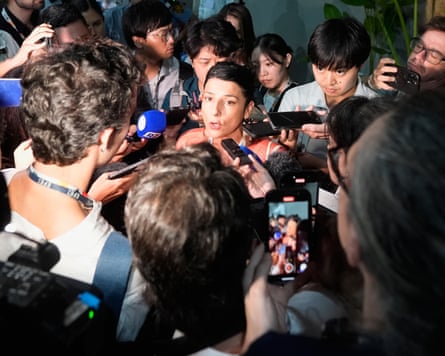 Irene Vélez Torres, Colombia’s minister of environment and sustainable development, speaks at the COP30 UN climate summit, 21 November 2025, in Belem, Brazil. Photograph: Fernando Llano/AP
theguardian.com
Irene Vélez Torres, Colombia’s minister of environment and sustainable development, speaks at the COP30 UN climate summit, 21 November 2025, in Belem, Brazil. Photograph: Fernando Llano/AP
theguardian.com
 How big oil is cashing in on Iran war – The Latest
theguardian.com
How big oil is cashing in on Iran war – The Latest
theguardian.com
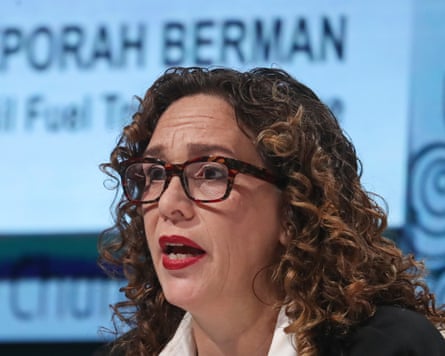 Tzeporah Berman, chair of the Fossil Fuel Treaty Initiative, says the Santa Marta conference was aimed at breaking through the deadlock that was stalling action on fossil fuel. Photograph: Igor Kovalenko/EPA
theguardian.com
Tzeporah Berman, chair of the Fossil Fuel Treaty Initiative, says the Santa Marta conference was aimed at breaking through the deadlock that was stalling action on fossil fuel. Photograph: Igor Kovalenko/EPA
theguardian.com
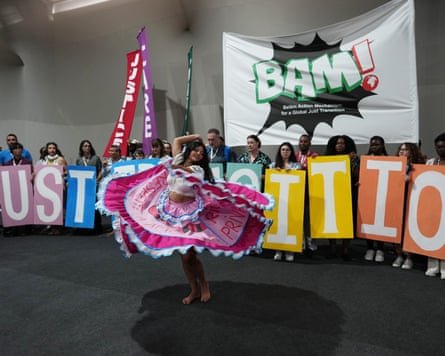 A protest for the Just Transition Away movement at last year’s COP. Photograph: André Penner/AP
theguardian.com
A protest for the Just Transition Away movement at last year’s COP. Photograph: André Penner/AP
theguardian.com
Colombia will host a two-day conference in Santa Marta on 28–29 April aimed at pushing countries to commit to a “transition away from fossil fuels”, according to The Guardian. The meeting is being co-convened with the Netherlands and has confirmed participation from 54 countries, including the UK, the EU, Canada, Australia and Turkey.
The gathering is explicitly designed as a workaround for the UN’s annual COP process, which has struggled to produce direct language on oil, gas and coal despite years of negotiations. The Guardian reports that organisers frame the Santa Marta meeting as a “coalition of the willing” that will proceed without states they describe as “boycotters or climate denialists”. That choice narrows the room: major producers and major emitters—among them the US, China, India, Russia and Gulf petro-states—are expected to be absent.
The Santa Marta format highlights a recurring problem in multilateral climate diplomacy: the countries most able to block language are often those with the most to lose from it. Colombia itself sits inside that tension. It is described by The Guardian as the largest coal and fourth-biggest oil exporter in the Americas, yet it is now positioning itself as a convenor of a process meant to accelerate an exit from the very exports that underpin state revenues and foreign exchange.
The timing is also shaped by energy security. The Guardian links the initiative to the price shock triggered by the recent US-Israeli attack on Iran and the disruption around the Strait of Hormuz, arguing that spikes in oil prices feed through into food prices, inflation and business costs. In that context, the conference is presented less as a moral appeal than as a hedge: countries that can credibly shift demand toward electrification and domestic renewables reduce exposure to geopolitical chokepoints.
But the numbers underline the limits of a willing-only club. The Guardian says the 54 confirmed participants represent roughly a fifth of global fossil-fuel production and about a third of demand. That may be enough to coordinate standards, finance and timelines among aligned governments, and to give COP31—co-chaired by Australia and Turkey—some pre-cooked language. It is not enough to settle the core question that COPs were built to handle: what happens when the largest suppliers and consumers refuse to sign.
The Santa Marta meeting will run for 48 hours. The countries most central to global oil and gas pricing will not be in the room.