
Donors pledge more than one billion euros for Sudan
Berlin conference raises funds as war enters fourth year, neither Sudanese army nor RSF shows up
Images
 Displaced people queue for food aid at a camp in Sudan. About 34 million people across the country need humanitarian assistance. Photograph: Marwan Ali/AP
theguardian.com
Displaced people queue for food aid at a camp in Sudan. About 34 million people across the country need humanitarian assistance. Photograph: Marwan Ali/AP
theguardian.com
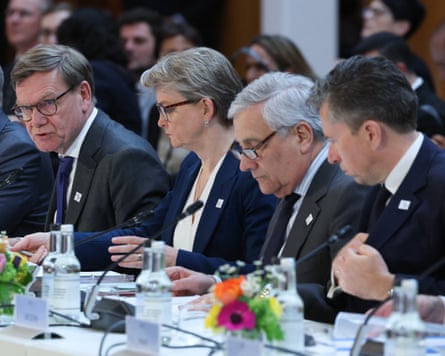 Delegates, including Germany’s foreign minister, Johann Wadephul (left), and the UK foreign secretary, Yvette Cooper, at the conference in Berlin. Photograph: Odd Andersen/AFP/Getty Images
theguardian.com
Delegates, including Germany’s foreign minister, Johann Wadephul (left), and the UK foreign secretary, Yvette Cooper, at the conference in Berlin. Photograph: Odd Andersen/AFP/Getty Images
theguardian.com
More than €1.3bn was pledged for Sudan at a donor conference in Berlin on Wednesday, according to the Guardian, surpassing an informal $1bn target set by German organisers. The money arrives as Sudan’s war enters its fourth year and as the UN estimates that roughly 34 million people—about two-thirds of the population—need humanitarian assistance.
The pledges help close only a fraction of the gap. The UN’s humanitarian appeal for Sudan this year is about £2.1bn, and the Guardian reports that just 16% has been funded so far. Even when money is promised, the limiting factor is often access and logistics rather than budgets on paper: aid convoys are blocked, routes are unsafe, and the state infrastructure that normally moves food, fuel and medicine has been hollowed out by three years of fighting.
Berlin’s meeting also underlined how little leverage donors have over the men with guns. Neither of the two main belligerents—the Sudanese army and the Rapid Support Forces—attended. Sudan’s army-aligned foreign ministry instead accused western states of a “colonial tutelage approach” for convening without it, a familiar posture for a government that wants international money without international conditions.
The war’s mechanics are also shifting in ways that make civilian life harder to protect and aid harder to deliver. Swedish public broadcaster SVT reports a rise in drone attacks this spring, with both sides using short- and long-range drones in a country whose flat terrain offers little cover. SVT cites a UN statement condemning attacks on civilians after at least 30 people, including children, were killed when a drone hit a wedding gathering in Kutum in North Darfur.
Diplomacy has become a carousel of formats without enforcement. The Guardian notes that US, Saudi, Egyptian and Emirati efforts—often described as a “Quad”—have failed to produce a meaningful ceasefire, while UN secretary general António Guterres told delegates that “credible allegations of the gravest international crimes” continue to emerge. Outside the Berlin venue, protesters chanted against the UAE over allegations it backs the RSF, which the UAE denies; Egypt is widely seen as aligned with the Sudanese military.
Aid can keep people alive for another month. It cannot reopen border crossings, stop drones over wedding tents, or persuade armed factions to trade battlefield advantage for paperwork in Berlin.
In Darfur, SVT reports, the nights are “compact darkness” with no electricity—broken only by sporadic gunfire and the sound of drones.