
Marwan Barghouti faces repeated assaults in Israeli custody
Lawyer alleges dog attack and medical denial after prison visits, a potential unity figure remains locked inside the system shaping Palestinian politics
Images
 Marwan Barghouti, pictured in 2004, has had demands for his release on the 24th anniversary of his imprisonment. Photograph: Uriel Sinai/Getty Images
theguardian.com
Marwan Barghouti, pictured in 2004, has had demands for his release on the 24th anniversary of his imprisonment. Photograph: Uriel Sinai/Getty Images
theguardian.com
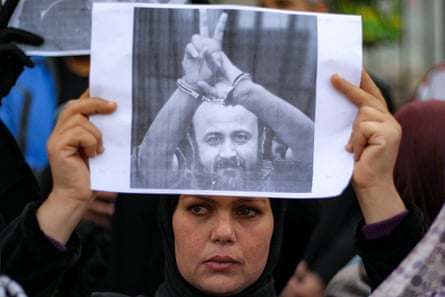 Protesters held images of Marwan Barghouti during a demonstration at the entrance of the Bureij camp for Palestinian refugees in April. Photograph: Eyad Baba/AFP/Getty Images
theguardian.com
Protesters held images of Marwan Barghouti during a demonstration at the entrance of the Bureij camp for Palestinian refugees in April. Photograph: Eyad Baba/AFP/Getty Images
theguardian.com
Marwan Barghouti, a 66-year-old Palestinian political figure serving multiple life sentences in Israel, has been attacked three times in three weeks inside the prison system, according to a statement by his lawyer after a visit. The Guardian reports that one incident on 25 March in Megiddo prison involved guards entering Barghouti’s cell with a dog and forcing him to the ground while the dog attacked him; further assaults allegedly followed during a transfer and again on 8 April at Ganot prison, where he was left bleeding and denied medical treatment.
Barghouti’s name carries weight far beyond the prison where he is held. He is one of the few Palestinian leaders with credibility across rival factions, and he has long been associated with the idea that a negotiated settlement is possible, having engaged Israeli officials before his arrest and advocated a two-state solution. That makes his treatment in custody more than a human-rights dispute: it touches a recurring problem in the conflict, where the prison system doubles as a political arena and where the state’s monopoly on detention becomes a lever in wider bargaining.
The details described by his lawyer are also part of a broader picture that has widened since the Gaza war: allegations of systemic abuse, medical neglect and inadequate food for Palestinian detainees. The Guardian notes that Israel’s supreme court has repeatedly ordered increases in food provision for prisoners, implying a gap between judicial instruction and prison practice. In institutions where oversight is intermittent and accountability is dispersed, daily conditions become a policy choice implemented by guards and administrators, not just by ministers and courts.
Israel has repeatedly refused calls to release Barghouti in prisoner exchanges, even as his supporters frame him as a potential unifying figure in Palestinian politics. On Wednesday, the 24th anniversary of his imprisonment, a new public appeal for his release gathered signatures from cultural figures including Cate Blanchett, Bryan Adams and Don Cheadle, alongside earlier backing from former global leaders, according to the report. Such campaigns do not change prison command structures, but they do raise the external cost of what happens inside them.
The lawyer described the visit itself as constrained: the two men were separated by glass and, without working phones, had to shout to communicate. Barghouti, he said, remained mentally sharp and focused on events outside.
Barghouti has been in Israeli custody since 2002, and the latest allegations hinge on what happened in his cell, during transfers, and in the hours after a beating when he says he was left without treatment.