
Turkey hit by second school shooting in two days
Kahramanmaraş attack kills at least four after 16 wounded in separate incident, reported weapon access points back to home storage
Images
 Footage showed people outside the school where the shooting is reported to have taken place
bbc.com
Footage showed people outside the school where the shooting is reported to have taken place
bbc.com
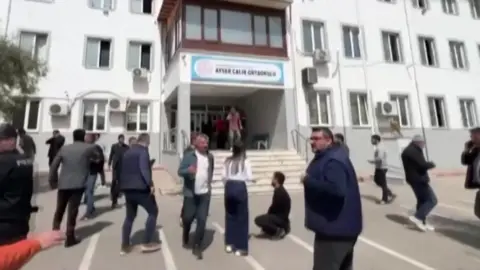 Footage showed people outside the school where the shooting is reported to have taken place
bbc.com
Footage showed people outside the school where the shooting is reported to have taken place
bbc.com
At least four people were killed in a shooting at Ayser Calık Secondary School in Kahramanmaraş in southern Turkey, the local governor said, according to Reuters. The attack came a day after a separate incident at another high school in southern Turkey left 16 people injured when an ex-student opened fire before killing himself. Turkish authorities have opened investigations into the incidents, and officials have not publicly confirmed the identities of the dead from the second shooting.
The proximity of the two attacks has forced a familiar set of questions back into the open: how weapons are obtained, how schools are secured, and how much of “prevention” is theatre. Turkish media cited by the BBC reported that the Kahramanmaraş attacker entered two classrooms and was carrying five guns and seven magazines, allegedly belonging to his father. If that account is accurate, the immediate policy problem is less about firearms circulating in public than about storage and access inside the home—rules that are difficult to enforce without routine inspections or some other mechanism that makes non-compliance costly.
Schools, meanwhile, sit at the intersection of high foot traffic and low tolerance for disruption. After a shooting, governments tend to reach for visible fixes—guards, gates, metal detectors, police patrols—because they can be deployed quickly and photographed. But the effectiveness depends on the attacker’s path: in both cases described by the BBC, the alleged shooters were not strangers to the school environment, and one was an ex-student. That shifts the problem from perimeter control to early detection and internal response, areas where institutions often rely on paperwork protocols and post-incident inquiries rather than continuous operational testing.
The second-order costs are borne locally. Each new layer of security adds staffing and procurement burdens to schools and municipalities, while parents absorb the less measurable costs: fear, disrupted routines, and the normalisation of screening at the school gate. In countries where public services are already strained, a security expansion can crowd out spending on teaching support and maintenance, even as officials promise that safety measures will be “prioritised.”
In Kahramanmaraş, the governor’s office announced the death toll and an investigation. The BBC reported that the attacker was able to reach two classrooms carrying multiple weapons.