
Chiang Mai Songkran tourism hit by wildfire smog
Northern Thailand’s annual burn season collides with Iran-war cost shock, Doi Suthep’s famous viewpoint turns into a grey health warning
Images
 Doi Suthep temple, one of the most famous in northern Thailand, which is known for its spectacular views of Chiang Mai and the lush forested mountains. Over recent weeks visitors can see little beyond a thick cloud of grey haze. Photograph: Rebecca Ratcliffe/The Guardian
theguardian.com
Doi Suthep temple, one of the most famous in northern Thailand, which is known for its spectacular views of Chiang Mai and the lush forested mountains. Over recent weeks visitors can see little beyond a thick cloud of grey haze. Photograph: Rebecca Ratcliffe/The Guardian
theguardian.com
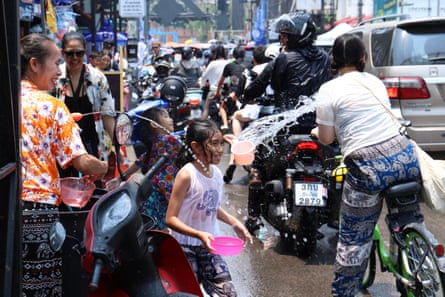 People take part in water fight celebrations which are part of the Songkran festival in Chiang Mai. Photograph: Xinhua/Shutterstock
theguardian.com
People take part in water fight celebrations which are part of the Songkran festival in Chiang Mai. Photograph: Xinhua/Shutterstock
theguardian.com
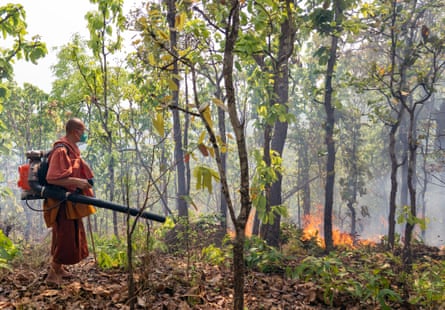 A Buddhist monk extinguishes a wildfire in a forest.
theguardian.com
A Buddhist monk extinguishes a wildfire in a forest.
theguardian.com
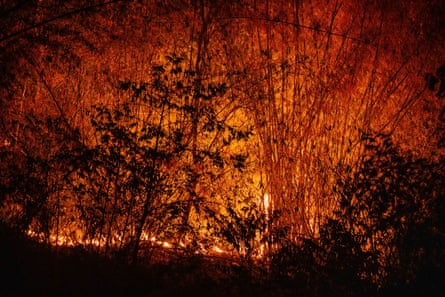 A hillside wildfire seen from a road in Chiang Mai.
theguardian.com
A hillside wildfire seen from a road in Chiang Mai.
theguardian.com
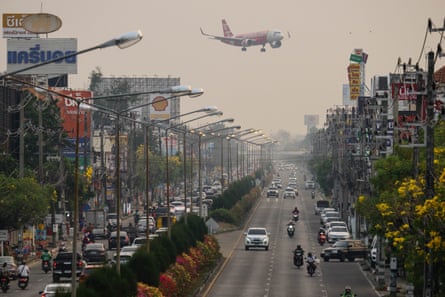 A passenger plane prepares to land at Chiang Mai airport amid heavy pollution. Photograph: Anthony Wallace/AFP/Getty
theguardian.com
A passenger plane prepares to land at Chiang Mai airport amid heavy pollution. Photograph: Anthony Wallace/AFP/Getty
theguardian.com
Wildfire smoke pushed Chiang Mai into IQAir’s list of the world’s most polluted cities during Songkran this week, with Thailand’s space agency counting 4,579 fire hotspots nationwide on Monday. Three northern provinces declared emergencies as hospitals reported a jump in pollution-related illnesses, according to The Guardian. At Doi Suthep, a temple lookout that normally sells the city’s mountain air as an attraction, visitors saw only a grey lid of haze.
The timing matters because Songkran is not just a holiday but a revenue event. Tour operators told The Guardian that cancellations have accelerated in the run-up to the water festival, with one Chiang Mai-based company reporting that roughly half its customers had dropped out in recent weeks and that it was cancelling most holiday tours because traffic, fuel and operating costs made them uneconomic. Thailand’s tourism authority has already revised down its national target for international arrivals by as much as 18%, blaming disrupted flights and higher costs linked to the US–Israel war with Iran.
Chiang Mai’s annual smoke season is not a mystery, and the persistence of it points to a problem of enforcement and contracting rather than weather alone. The haze is driven by forest fires and by post-harvest burning, an illegal practice that continues because many farmers lack machinery to clear fields quickly. A clean-air network cited by The Guardian links the burning to financial pressure on smallholders who supply large agribusinesses on contract: when the buyer demands volume and timing but does not supply equipment, the cheapest tool left is a match. Authorities have attempted stopgaps such as cloud-seeding and “artificial rain”, but the smoke has remained.
The second-order effect is that a local environmental failure is being priced into a national export: tourism. Northern Thailand sells “fresh air” and outdoor experiences; when the air becomes a health warning, the product collapses. Meanwhile, the same regional war that has tightened energy markets also raises the cost base for hotels, transport and tours, making it harder for businesses to discount their way out of weaker demand. The result is a squeeze from both sides—fewer visitors and higher inputs—landing on small operators first.
The public-health dimension has also become harder to ignore. The Guardian notes that high-profile cases, including a young doctor and clean-air campaigner who died after being diagnosed with lung cancer, have shaken local opinion. When the most visible local advocates are themselves victims, the question shifts from seasonal inconvenience to chronic exposure.
On Monday, while tourists bought water pistols for Songkran fights in the old city, the view from Doi Suthep remained a wall of smoke.