
US announces naval blockade of Iranian ports
Centcom says Hormuz transit for other countries continues, ship-tracking data shows only four tankers crossing ahead of start time
Images
 bbc.com
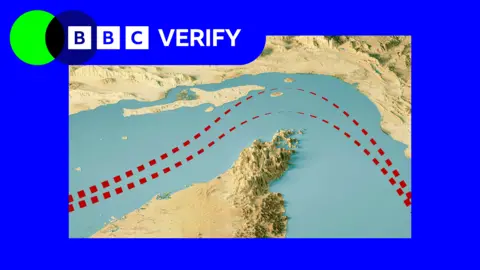 Getty Images A satellite image of the Strait of Hormuz with two red lines to show shipping lanes.
bbc.com
Getty Images A satellite image of the Strait of Hormuz with two red lines to show shipping lanes.
bbc.com
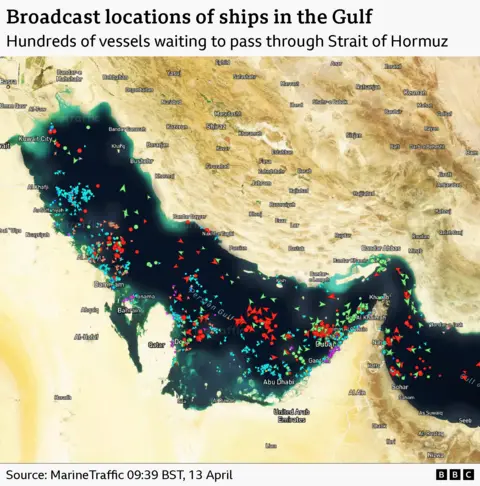 A satellite image of the Strait of Hormuz with ships marked with arrows. It shows hundreds of ships clustered by the strait waiting to pass. It is timestamped to 09:39 BST on 13 April
bbc.com
A satellite image of the Strait of Hormuz with ships marked with arrows. It shows hundreds of ships clustered by the strait waiting to pass. It is timestamped to 09:39 BST on 13 April
bbc.com
US Central Command says it will begin a naval blockade of maritime traffic entering or exiting Iranian ports at 14:00 GMT on Monday, a move that formalises the Strait of Hormuz as the operational centre of the six-week US-Israel war with Iran. According to BBC Verify, only four vessels had transited the strait by Monday morning, all tankers carrying oil, gas or chemicals, and none could be identified as travelling to or from Iranian ports.
The blockade is designed to be selective: Centcom said it would “not impede” ships transiting the strait to or from other countries. In practice, the distinction matters less than the enforcement problem. Shipping movements and declared origins rely on AIS transponder data broadcast by vessels themselves, and BBC Verify notes that none of the ships it tracked listed an Iranian port as their origin. That creates a predictable grey zone for shipowners, insurers and banks: if a tanker’s declared paperwork is ambiguous, the commercial risk shifts from the cargo to the voyage itself.
Before the conflict began on 28 February, an average of 138 ships passed through Hormuz each day, according to the Joint Maritime Information Center, a multinational maritime coordination hub. BBC Verify tracked 23 transits since ceasefire talks broke down early Sunday, and says at least 16 were linked to Iran, flew the Iranian flag, or had been sanctioned for Iranian ties. Lloyd’s List editor-in-chief Richard Meade told the BBC that shipowners still assume Iran retains de facto control of the passage, including through the Islamic Revolutionary Guard Corps, because the strait’s narrow geography makes harassment cheap and constant.
That uncertainty is already reshaping behaviour at sea. BBC Verify’s route analysis shows vessels hugging the northern track close to Iran’s coastline, within Iranian territorial waters, rather than using the more central channel typical before the war. The IRGC Navy has published what it says are “permitted routes” to avoid sea mines and marked the middle of the channel as a “dangerous area”. The International Chamber of Shipping’s secretary general, Thomas Kazakos, told the BBC that shipowners need clear confirmation on navigation safety for crews and vessels.
The immediate backlog is large enough to become its own economic pressure. Meade said nearly 800 ships have been “stuck” in the Gulf for weeks and that, if traffic resumes, fully loaded tankers will be prioritised to move out first. That sequencing concentrates risk: the highest-value cargoes and the most time-sensitive charters are the ones that have to test whether the blockade’s rules can be applied cleanly.
By Monday morning, four tankers had crossed Hormuz while the blockade’s start time approached. BBC Verify said it could not identify any of them as bound for Iranian ports.