
Lagos Lagoon dredging deepens channels for building sand
NIOMR study finds seabed eroded by nearly six metres near Banana Island, fishing communities pay in fuel and lost shoreline
Images
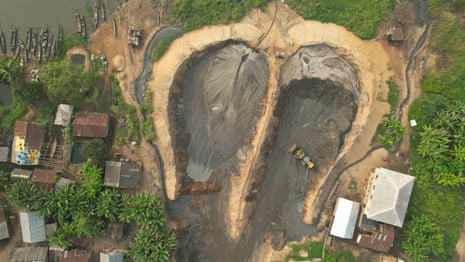 Dredging leaves its mark on the landscape along the shores of the Lagos Lagoon in Epe
theguardian.com
Dredging leaves its mark on the landscape along the shores of the Lagos Lagoon in Epe
theguardian.com
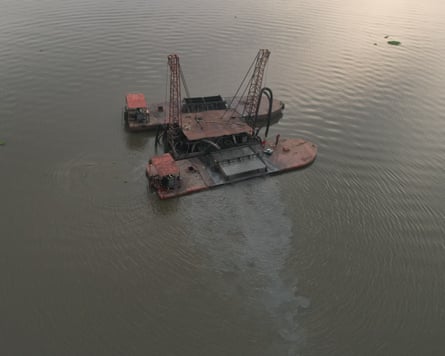 A dredging barge operating on Lagos Lagoon with sediment plumes spreading out behind it as it extracts material from the riverbed
theguardian.com
A dredging barge operating on Lagos Lagoon with sediment plumes spreading out behind it as it extracts material from the riverbed
theguardian.com
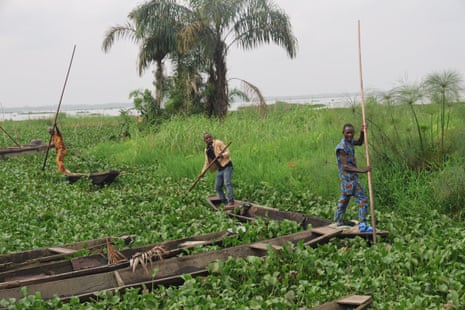 Fishers in Oto-Awori struggle to paddle through water hyacinths back to the jetty
theguardian.com
Fishers in Oto-Awori struggle to paddle through water hyacinths back to the jetty
theguardian.com
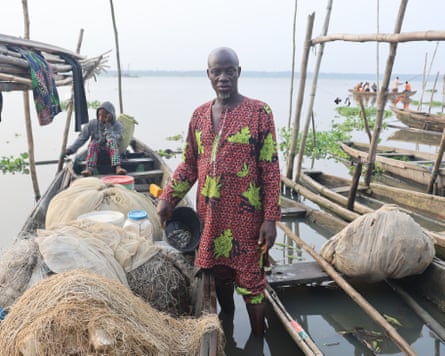 Fasasi Adekunle, a fisher in Epe, with his meagre catch in a small bucket
theguardian.com
Fasasi Adekunle, a fisher in Epe, with his meagre catch in a small bucket
theguardian.com
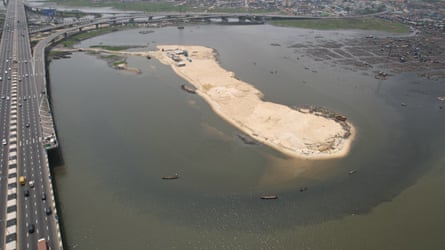 Sand dredging beside the busy Third Mainland Bridge, spilling into Makoko – Nigeria’s largest floating community – where a newly formed sandbank rises from the lagoon
theguardian.com
Sand dredging beside the busy Third Mainland Bridge, spilling into Makoko – Nigeria’s largest floating community – where a newly formed sandbank rises from the lagoon
theguardian.com
Sand dredgers on Lagos Lagoon have carved out pits and thrown up new sandbanks as builders feed a construction boom in a city of more than 20 million people. In the Epe area east of central Lagos, fishers told the Guardian they now travel farther, burn more fuel and return with smaller catches; one said a night’s haul that once brought in about 30,000 naira now often yields little more than a bucket.
The lagoon is not just scenery beside the Third Mainland Bridge. It is a working system that supports fisheries, transport and shoreline communities, and it absorbs the daily waste and runoff of a megacity. When dredging deepens channels and strips the bed, it changes currents and stirs sediment plumes that can smother breeding grounds and disrupt the food chain. The Guardian cites a Nigerian Institute for Oceanography and Marine Research (NIOMR) study finding the seabed eroded by nearly six metres along a roughly five-kilometre stretch between reclaimed Banana Island and the nearby Third Mainland Bridge—an area that also functions as a key artery linking Lagos’s island districts to the mainland.
Regulation nominally sits with Lagos state and the waterways authority, but demand for “sharp sand” used in concrete and land reclamation creates a market where the cheapest supply wins and oversight becomes optional. The benefits are concentrated: developers get fill material for estates, flyovers and high-rise projects; the costs are dispersed into falling fish stocks, damaged nets, longer trips, higher fuel bills and shoreline erosion that pushes homes toward the water each rainy season. Residents in Oto-Awori and Era Town described watching land disappear while sand extracted from their waters is sold back to the city as “development.”
The lagoon’s degradation also shows up as second-order effects that do not fit neatly into a permit application. Water hyacinths clog waterways and can trap boats; newly formed sandbanks alter navigation and redirect flows toward vulnerable banks. Once erosion accelerates, communities often respond with improvised barriers, while government projects—if they arrive—tend to prioritise high-value real estate and transport infrastructure over fishing settlements.
Lagos’s building boom is visible in concrete and glass. The lagoon’s bill arrives in smaller fish baskets, longer paddling routes, and shorelines that move a little closer to people’s doorsteps each season.