
China narrows AI model gap with US
Export controls keep Nvidia chips as Washington leverage, race shifts from best chatbot to who can deploy at scale
Images
 bbc.com
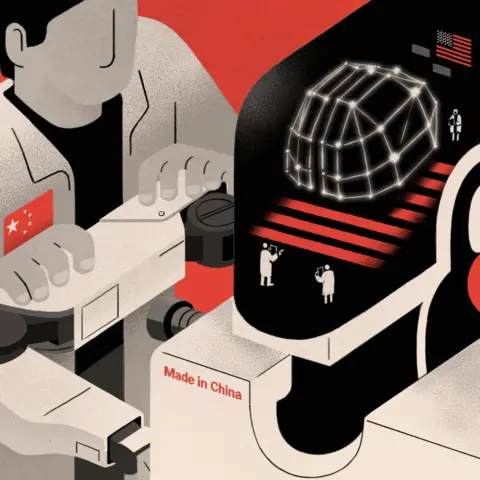 BBC An illustration showing a worker with a Chinese flag on their chest operating a robot with the words "Made in China" on its front. Small human figures under a US flag are inside the robot's "brain"
bbc.com
BBC An illustration showing a worker with a Chinese flag on their chest operating a robot with the words "Made in China" on its front. Small human figures under a US flag are inside the robot's "brain"
bbc.com
 The US ensures useful machines made by Dutch firm ASML do not reach China
bbc.com
The US ensures useful machines made by Dutch firm ASML do not reach China
bbc.com
China and the United States are now trading leads in different parts of the AI stack, with China narrowing the gap on large language models while the US keeps leverage through the chips and tooling that train them. The BBC reports that the contest is increasingly framed as “brains” versus “bodies”: conversational models and the compute behind them on one side, robotics and deployment at scale on the other.
On “brains”, the US still has the most widely used consumer systems and the companies spending the largest sums to build them. The BBC cites OpenAI’s claim that ChatGPT has roughly 900 million weekly users, and points to rivals such as Anthropic, Google and Perplexity pouring billions into model training and productisation. But the same article describes Chinese labs and firms pushing quickly up the capability curve, in part by adapting open-source models and building domestic alternatives that fit China’s language, platforms and regulatory environment.
Washington’s advantage, according to a senior US official quoted by the BBC, is less about code than about hardware: access to the most capable AI chips and the industrial ecosystem around them. Nvidia-designed accelerators dominate high-end training, and US policy has increasingly tried to keep the best versions out of China via export controls tightened since 2022. Those controls do not just target chips; they also touch the specialised equipment and supply chains that make cutting-edge semiconductors possible, including tools produced outside the US but sold under licensing regimes influenced by Washington.
The second-order effect is that the “AI race” is no longer a single leaderboard. If the US can restrict frontier compute but China can field large numbers of good-enough systems, the battleground shifts from peak model scores to deployment: which economy can embed AI into manufacturing, logistics, surveillance, customer service and weapons procurement without being throttled by energy costs, liability risk or regulation. The BBC notes China’s relative strength in “AI bodies” such as robotics, where mass production and integration into factories matter as much as research breakthroughs.
For allies and smaller states, the split creates an awkward menu of dependencies. Using US-origin chips and cloud stacks may come with compliance obligations and potential cut-offs; using Chinese systems may come with security concerns and political strings. The more export controls harden into industrial policy, the more “AI sovereignty” becomes a procurement problem—who can buy compute, who can insure it, and who can legally update it.
The BBC’s portrait of the race begins with a consumer chatbot launch in late 2022, but it ends with a supply chain question. The most valuable company in the world can still be the one that sells the shovels.