
Ashifa Kassam: Transcript shows Orbán tells Putin I am at your service
Leak lands as JD Vance campaigns in Budapest, EU unanimity turns loyalty into leverage
Images
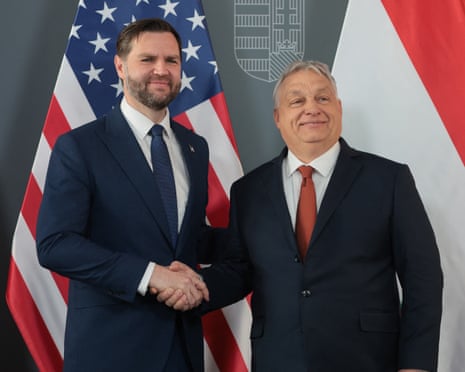 The revelations come as JD Vance, left, joins Viktor Orbán in Budapest on Tuesday to take part in his election campaign. Photograph: Jonathan Ernst/AFP/Getty Images
theguardian.com
The revelations come as JD Vance, left, joins Viktor Orbán in Budapest on Tuesday to take part in his election campaign. Photograph: Jonathan Ernst/AFP/Getty Images
theguardian.com
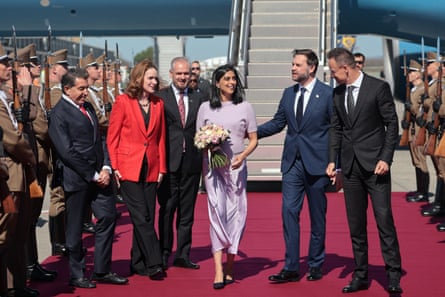 The Hungarian foreign minister, Péter Szijjártó (right), welcomes JD Vance (second from right) and his wife, Usha (third from right), as they arrive in Budapest on Tuesday. Photograph: Jonathan Ernst/AFP/Getty Images
theguardian.com
The Hungarian foreign minister, Péter Szijjártó (right), welcomes JD Vance (second from right) and his wife, Usha (third from right), as they arrive in Budapest on Tuesday. Photograph: Jonathan Ernst/AFP/Getty Images
theguardian.com
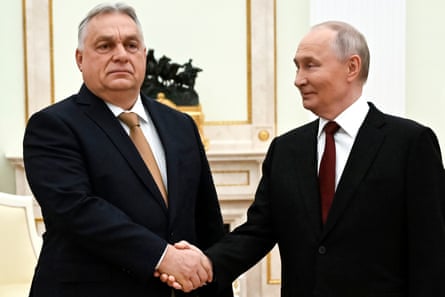 Viktor Orbán and Vladmir Putin at the Senate Palace in Moscow in November last year. Photograph: Alexander Nemenov/AP
theguardian.com
Viktor Orbán and Vladmir Putin at the Senate Palace in Moscow in November last year. Photograph: Alexander Nemenov/AP
theguardian.com
A transcript of an October phone call between Viktor Orbán and Vladimir Putin has surfaced just as Hungary enters the final days of a close election campaign and as US vice-president JD Vance appears in Budapest to back the incumbent. Bloomberg News reported it obtained a Hungarian government transcript in which Orbán told Putin “I am at your service” and compared Hungary to a mouse ready to help a Russian “lion”. The Guardian reports the revelation has reignited scrutiny of Budapest’s ties to Moscow.
The leak lands in a familiar place: Hungary is a member of the EU and Nato, yet it has repeatedly slowed or softened collective moves against Russia, from sanctions to messaging. According to the Guardian, European leaders have in recent days reacted to other leaked audio that appeared to capture foreign minister Péter Szijjártó discussing changes to the EU sanctions list with his Russian counterpart Sergei Lavrov. The pattern is less about a single conversation than about how a small state can trade veto leverage for attention, exceptions and side-deals.
Orbán’s domestic politics makes that leverage valuable. When EU funds, regulatory disputes and rule-of-law procedures become permanent background noise, a leader benefits from framing Brussels as an external adversary while keeping the cash flowing. A posture of “independence” also plays well in a campaign that, according to the Guardian, has been shaken by scandals and tightened by the rise of challenger Péter Magyar, a former figure inside the governing Fidesz orbit. If the election is close, every external endorsement or perceived threat becomes usable material.
Washington’s involvement adds another layer. The Guardian notes Donald Trump has repeatedly praised Orbán, and Vance’s visit is presented as an effort to bolster him as polling narrows. For Budapest, US attention can be monetised as legitimacy at home and bargaining power abroad; for US politicians, Orbán is a convenient symbol in a wider argument about “Brussels” and cultural politics. None of this requires alignment on Hungarian living standards, energy prices or public services—only alignment on narratives.
Russia’s interest is simpler: one friendly capital inside EU decision-making can slow coordination at low cost. The Guardian reports allegations that Russian intelligence and linked disinformation networks are working to sway the vote. Even partial success—delays, carve-outs, procedural friction—can matter when sanctions lists and military support packages require consensus.
Orbán, for his part, is portrayed in the transcript as offering help “in any matter where I can be of assistance”. In a bloc that runs on committees, unanimity and exemptions, assistance does not have to be dramatic to be useful.
Vance arrived in Budapest on Tuesday. The transcript describes Orbán offering his services to Putin on 17 October.