
Gunman killed in shootout near Israeli consulate in Istanbul
Turkish officials say consulate has been effectively empty for over two years, attack targets a symbol more than staff
Images
 bbc.com
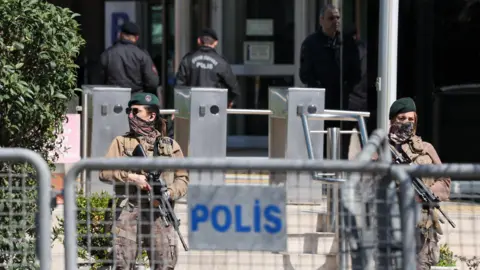 Reuters Two Turkish Police's special forces stand guard holding rifles
bbc.com
Reuters Two Turkish Police's special forces stand guard holding rifles
bbc.com
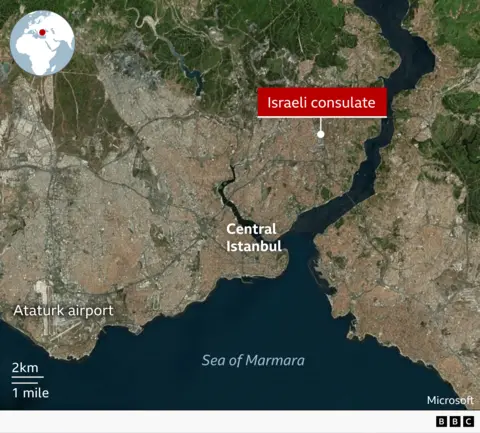 Satellite map of Istanbul showing the location of the Israeli consulate in the north of the European side of the city, marked with a red label. The map also labels Istanbul city centre, Ataturk Airport to the southwest, and the Sea of Marmara to the south. A small inset globe in the top left shows Turkey’s position in the world between Asia and Europe.
bbc.com
Satellite map of Istanbul showing the location of the Israeli consulate in the north of the European side of the city, marked with a red label. The map also labels Istanbul city centre, Ataturk Airport to the southwest, and the Sea of Marmara to the south. A small inset globe in the top left shows Turkey’s position in the world between Asia and Europe.
bbc.com
A gunman was killed and two people were wounded in a shootout near Israel’s consulate in Istanbul on Monday, Turkish authorities said. Turkey’s interior ministry said two police officers were “slightly injured” and that the attackers had arrived from the nearby city of Izmit in a rented car, according to the BBC.
The incident comes at a moment when Israeli diplomatic premises in Turkey are more symbol than operating facility. Governor Davut Gul said no Israeli diplomatic personnel were inside the building, and the BBC reports the consulate has been effectively empty for roughly two and a half years amid deteriorating Ankara–Tel Aviv relations over the war in Gaza. That detail matters operationally: an attack on an unstaffed site is less about hostage-taking or direct diplomatic leverage and more about visibility, messaging and testing security responses in a busy district.
Turkish officials framed the episode as a counter-terrorism case. The interior ministry identified the dead gunman as Yunus E.S. and said he was connected to “the terrorist organisation that exploits religion”—a phrasing commonly used for Islamic State—though no group has claimed responsibility. Two injured attackers, Onur Ç and Enes Ç, were described as brothers; authorities said they were being interrogated and that “intensive digital communication” had been detected among the three.
The mechanics of the attack also point to a domestic security problem that foreign-policy headlines can obscure. Gul said the assailants used rifles and pistols, and a Reuters witness described sustained gunfire for 15–20 minutes, suggesting either a prolonged engagement or difficulty rapidly sealing the area. Social media videos circulating after the incident showed a large police response and a cordon around the building for hours.
For Turkey, the incentives are conflicted. Ankara has positioned itself as a vocal critic of Israel’s Gaza campaign while also trying to avoid becoming a permissive environment for transnational militants. For Israel, the episode reinforces the logic of leaving posts shuttered and relying on local security—an arrangement that reduces exposure but also reduces diplomatic presence at a time when channels are already thin.
Turkey’s justice minister said an investigation had been opened. The consulate in Besiktas remained a cordoned-off building in Istanbul’s business district after the gunfire stopped.