
Ben Roberts-Smith charged with five war crime murders
Australia arrests its most decorated living soldier after defamation findings, prosecutors must build a case without Afghan crime-scene access
Images
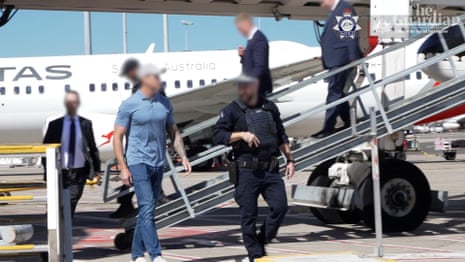 Ben Roberts-Smith arrested by Australian federal police at Sydney airport – video
theguardian.com
Ben Roberts-Smith arrested by Australian federal police at Sydney airport – video
theguardian.com
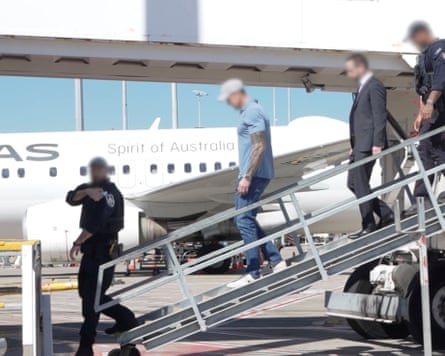 Ben Roberts-Smith was arrested after flying from Brisbane to Sydney. Photograph: AFP
theguardian.com
Ben Roberts-Smith was arrested after flying from Brisbane to Sydney. Photograph: AFP
theguardian.com
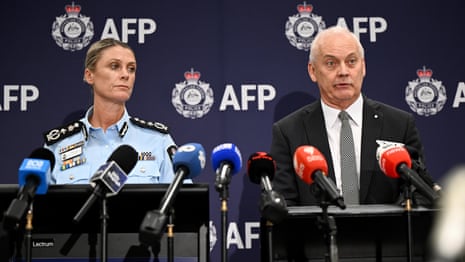
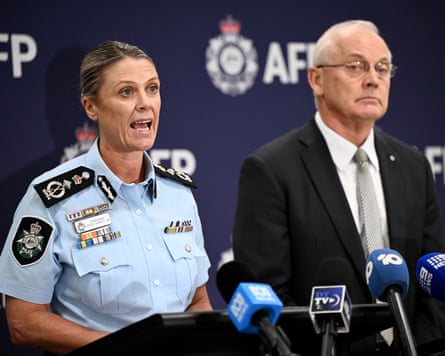 Australian federal police commissioner Krissy Barrett and Ross Barnett, the director of investigations at the Office of the Special Investigator. Photograph: Bianca de Marchi/AAP
theguardian.com
Australian federal police commissioner Krissy Barrett and Ross Barnett, the director of investigations at the Office of the Special Investigator. Photograph: Bianca de Marchi/AAP
theguardian.com
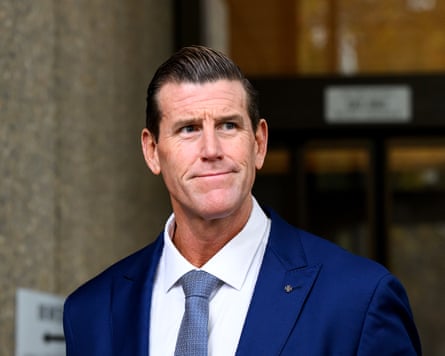 Ben Roberts-Smith outside the federal court in May. Photograph: Bianca de Marchi/AAP
theguardian.com
Ben Roberts-Smith outside the federal court in May. Photograph: Bianca de Marchi/AAP
theguardian.com
 Details of Ben Roberts-Smith arrest revealed by AFP commissioner - video
theguardian.com
Details of Ben Roberts-Smith arrest revealed by AFP commissioner - video
theguardian.com
Ben Roberts-Smith was arrested at Sydney airport on Tuesday and charged with five counts of war crime murder over alleged killings of Afghan civilians during SAS operations between 2009 and 2012. According to the Guardian, Australian federal police said the charges relate to three incidents and carry a maximum penalty of life imprisonment. Roberts-Smith, a Victoria Cross recipient and Australia’s most decorated living veteran, is due to appear in bail court on Wednesday and spent Tuesday night in Silverwater prison.
The case lands after years of institutional inquiry that began not in a criminal court but in the press and a civil defamation trial. Roberts-Smith previously sued three newspapers over reporting that he murdered unarmed detainees and bullied fellow soldiers; a federal court found, on the civil standard of the balance of probabilities, that key allegations were substantially true. That earlier judgment did not put him behind bars, but it created a public factual record, named locations and episodes, and forced witnesses into the open under cross-examination—material that inevitably shaped what could later be tested to the criminal standard.
Investigators now have to build a war-crimes prosecution without the normal conveniences of a domestic homicide case. Ross Barnett, director of investigations at the Office of the Special Investigator, said the inquiry started in 2021 and has been conducted “under challenging circumstances”, including the inability to access Afghan crime scenes. That means no site plans, no recovered projectiles, no blood-spatter work, and no postmortems establishing official causes of death. In effect, the state is asking a court to reconstruct battlefield events largely from testimony, military records and whatever contemporaneous documentation can be authenticated years later.
That constraint cuts both ways. Without physical forensics, prosecutors lean harder on witness credibility and chain-of-command evidence—who gave orders, who was present, who controlled subordinates—while the defence can probe memory, motive, and the pressures inside a small special-forces community. The Guardian reports police allege some victims were “detained, unarmed and under the control” of Australian Defence Force members when they were killed, and that in at least one episode a subordinate may have fired under Roberts-Smith’s control. Those details point directly at the organisational problem that has shadowed Afghanistan-era deployments: elite units operating at speed, far from scrutiny, with internal incentives to protect reputations and careers.
The arrest also tests Australia’s willingness to convert reputational accountability into legal accountability. A defamation loss can be absorbed as a career-ending scandal; a criminal conviction would establish a precedent that decorations and institutional prestige are not a shield. But a failed prosecution—after years of investigation and public expectation—would send a different message: that distance, time, and operational secrecy make wartime accountability largely symbolic.
Roberts-Smith was arrested at the domestic terminal after flying from Brisbane to Sydney, police said. He is expected to return to court on Wednesday, while the alleged killings remain pinned to place names—Whiskey 108, Darwan, Syahchow—that investigators still cannot visit.