
Israeli drone strikes hit Maghazi area in central Gaza
Clashes erupt between Hamas security forces and Israel-backed militia, ceasefire becomes a contest over checkpoints and disarmament
Images
 Relatives of those killed during the clashes mourned outside al-Aqsa hospital in Deir al-Balah
bbc.com
Relatives of those killed during the clashes mourned outside al-Aqsa hospital in Deir al-Balah
bbc.com
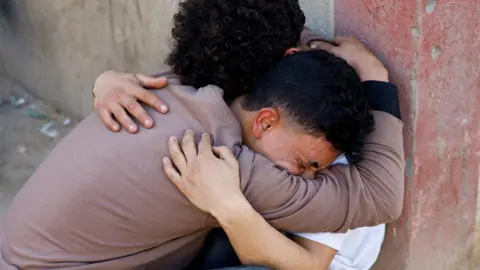 Relatives of those killed during the clashes mourned outside al-Aqsa hospital in Deir al-Balah
bbc.com
Relatives of those killed during the clashes mourned outside al-Aqsa hospital in Deir al-Balah
bbc.com
At least 10 Palestinians were killed on Monday in central Gaza after Israeli drone strikes hit an area east of the Maghazi refugee camp, according to local hospital officials cited by the BBC. Al-Aqsa hospital in Deir al-Balah said it received 10 bodies from the scene and reported dozens more wounded, some critically. Witnesses told the BBC the strikes followed a firefight between Hamas security personnel and a Palestinian militia described as backed by Israel.
The episode illustrates how Gaza’s war has shifted from set-piece battles to a contested security vacuum where armed groups compete to control checkpoints, aid routes and local policing. According to the BBC report, the militia established a checkpoint east of Maghazi and came under attack from Hamas security forces, triggering clashes; Israeli drones then intervened, striking Hamas personnel in three locations. Neither the Israeli military nor Hamas immediately commented, and the BBC noted the sequence of events remained unclear.
Israel and Hamas have repeatedly accused each other of violating the ceasefire agreed almost six months ago. The BBC cites Gaza’s Hamas-run health ministry as saying at least 723 Palestinians have been killed in Israeli attacks since the ceasefire, while the Israeli military says five of its soldiers have been killed in attacks by Palestinian groups over the same period. The numbers are not directly comparable—one counts all deaths in Gaza, the other reports military fatalities—but they signal the same reality: the ceasefire functions less as a stop to violence than as a new operating environment.
That environment is now shaped by a political fight over disarmament. The BBC reports that a Hamas delegation recently met Egyptian, Qatari and Turkish mediators in Cairo to give an initial response to a proposal from the US-led Board of Peace calling on Palestinian groups to decommission weapons, a key sticking point for moving to a second phase of US President Donald Trump’s “20-point” plan. On Sunday, Abu Ubaida, spokesman for Hamas’s military wing, rejected disarmament talks before Israel fulfils first-phase commitments, arguing that weapons cannot be negotiated away after surviving Israel’s ground campaign.
The Maghazi incident also points to a practical dilemma for any post-war governance plan: whoever tries to administer Gaza must first outcompete—or co-opt—armed actors who can set up roadblocks and enforce their own rules. A militia that can operate a checkpoint with Israeli support changes Hamas’s internal calculus, but it also creates a new local power center whose loyalty and discipline are not guaranteed.
By Monday evening, al-Aqsa hospital in Deir al-Balah had counted 10 dead from the clashes near Maghazi. The trigger, witnesses said, was a checkpoint.