
Artemis II sets new human distance record, Orion crew flies past Moon on non-landing test mission
A 40-minute communications blackout is still part of the plan
Images
 In this photo provided by Nasa, the moon is seen in the window of the Orion spacecraft at the end of day five of a journey to the moon. Photograph: AP
theguardian.com
In this photo provided by Nasa, the moon is seen in the window of the Orion spacecraft at the end of day five of a journey to the moon. Photograph: AP
theguardian.com
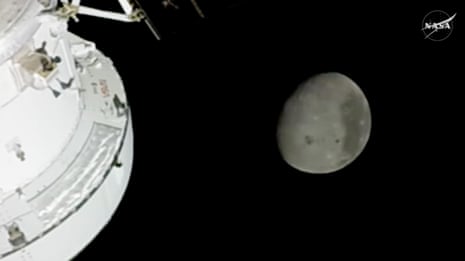 Artemis II astronauts travel further from Earth than any humans before – watch live
theguardian.com
Artemis II astronauts travel further from Earth than any humans before – watch live
theguardian.com
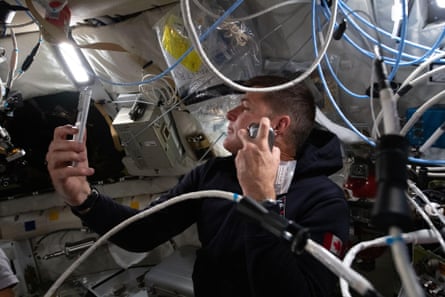 Astronaut Jeremy Hansen enjoys a shave inside the Orion spacecraft ahead of the crew’s lunar flyby on Monday. Photograph: Nasa
theguardian.com
Astronaut Jeremy Hansen enjoys a shave inside the Orion spacecraft ahead of the crew’s lunar flyby on Monday. Photograph: Nasa
theguardian.com
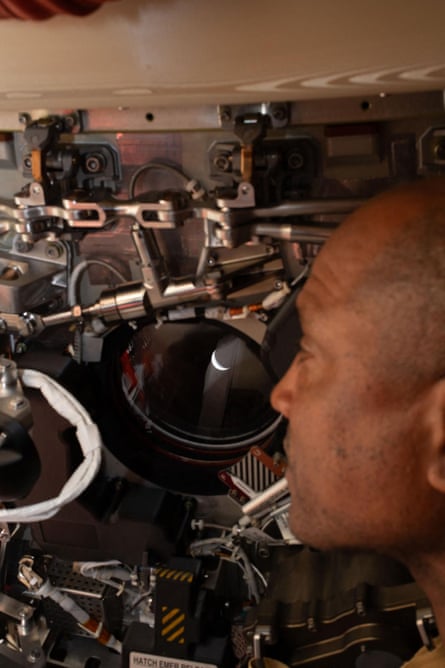 Astronaut Victor Glover peers out one of the Orion spacecraft’s windows looking back at Earth ahead of the crew’s lunar flyby on Monday. Photograph: Nasa/AFP/Getty Images
theguardian.com
Astronaut Victor Glover peers out one of the Orion spacecraft’s windows looking back at Earth ahead of the crew’s lunar flyby on Monday. Photograph: Nasa/AFP/Getty Images
theguardian.com
Artemis II passed the Moon on Monday and pushed a four-person crew farther from Earth than any human has travelled, according to The Guardian, beating the distance record set by Apollo 13 in 1970. Nasa said the Orion capsule crossed the mark during the fifth day of the mission, before swinging around the far side of the Moon for a planned communications blackout of roughly 40 minutes.
The flight is a rehearsal rather than a landing attempt. Artemis II is designed to validate Orion’s life-support, navigation and heat-shield performance on a crewed lunar trajectory, a prerequisite for later missions that aim to put astronauts back on the lunar surface. The record itself is a by-product of the chosen path: the spacecraft is expected to travel about 8,000km beyond the Moon, placing it at a maximum distance several thousand miles beyond Apollo 13’s high-water mark.
The immediate payoff is operational: deep-space communications, power management and crew routines have to hold up when the vehicle is too far for rapid intervention and periodically out of contact. The blackout on the Moon’s far side is a reminder that, even in an era of constant connectivity, lunar missions still include dead zones where crews must execute procedures without real-time ground guidance. Those constraints are part of what Artemis is trying to normalise after decades in which human spaceflight has largely stayed in low Earth orbit.
The mission also functions as a public demonstration of endurance and intent. The crew—Reid Wiseman, Victor Glover and Christina Koch from Nasa and Canada’s Jeremy Hansen—used the milestone to send messages that implicitly frame Artemis as a program meant to outlast a single news cycle. Hansen, The Guardian reports, challenged “this generation and the next” to ensure the record “is not long-lived,” a line that doubles as a pitch for sustained funding and follow-on missions.
Inside the capsule, the symbolic layer is being built in real time. The Guardian reports the astronauts discussed proposing names for lunar craters, including one in honour of Wiseman’s late wife, and another tied to the spacecraft. Such gestures are small compared with the program’s price tag, but they are part of the way space agencies turn engineering test flights into national narratives—useful when budgets and schedules come up for debate.
Artemis II is expected to continue its loop back toward Earth after the flyby. For a few minutes on Monday, the most advanced spacecraft Nasa has flown in decades was also just a cramped cabin with four people watching the Moon slide past a window.