
Russia introduces crypto bills to formalise trading
Non-qualified investors capped at 300000 rubles per year, legal grey zone narrows into licensed intermediaries
Images
 Russia Moves to Formalize Cryptocurrency Market With New Legislation
news.bitcoin.com
Russia Moves to Formalize Cryptocurrency Market With New Legislation
news.bitcoin.com
 Russia Moves to Formalize Cryptocurrency Market With New Legislation
news.bitcoin.com
Russia Moves to Formalize Cryptocurrency Market With New Legislation
news.bitcoin.com
 Central Bank of Russia Proposes Opening National Economy to International Markets Using Digital Assets
news.bitcoin.com
Central Bank of Russia Proposes Opening National Economy to International Markets Using Digital Assets
news.bitcoin.com
 Central Bank of Russia Proposes Opening National Economy to International Markets Using Digital Assets
news.bitcoin.com
Central Bank of Russia Proposes Opening National Economy to International Markets Using Digital Assets
news.bitcoin.com
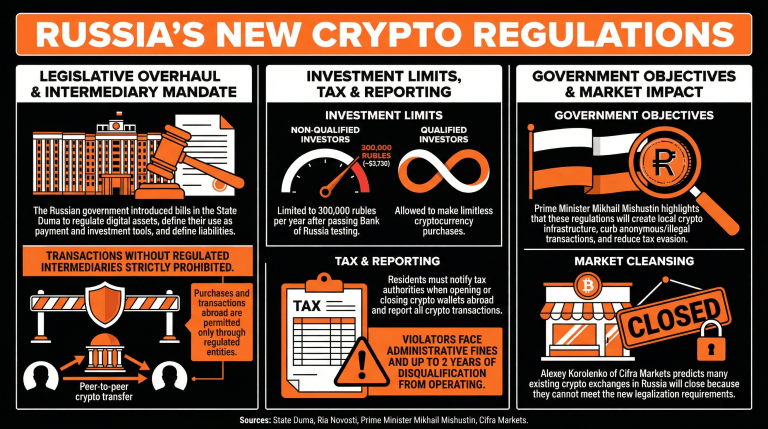
Russia’s parliament has introduced three bills to pull cryptocurrency trading out of the country’s legal grey zone and into a tightly supervised market. The package would cap annual crypto purchases by “non-qualified” investors at 300,000 rubles (about $3,700) per intermediary, require reporting of crypto wallets abroad, and punish unlicensed exchange activity with fines and potential bans from operating, according to Bitcoin.com.
The proposed framework is built around a simple condition: crypto transactions must run through regulated intermediaries. Direct dealings without approved platforms would be prohibited, while purchases and transactions abroad remain permitted if conducted via regulated channels. Prime Minister Mikhail Mishustin said the goal is to create domestic infrastructure for trading and custody while reducing anonymous transactions and tax evasion, Bitcoin.com reports.
The bills arrive as Russia tries to reconcile two competing realities. On one side, digital assets have become a practical tool for moving value across borders when conventional banking routes are constrained. On the other, a decentralised market makes it harder for the state to enforce capital controls, collect taxes, and police illicit finance. The proposed cap for non-qualified investors—paired with a Bank of Russia “testing” requirement—signals that retail participation is being treated less as consumer choice and more as a regulated risk category.
For existing operators, the bigger change is structural. By forcing activity into licensed venues and imposing reporting duties on offshore wallets, the state gains visibility into flows that previously sat outside routine supervision. That visibility also creates a lever: enforcement can be targeted at exchanges that fail to meet compliance standards, or at individuals who do not disclose holdings. Alexey Korolenko of Cifra Markets told Ria Novosti that a “purge” is likely, with many current Russian exchanges expected to shut because they cannot satisfy the new requirements.
That consolidation is not a side effect; it is the point. A market with fewer, larger intermediaries is easier to audit, easier to pressure, and easier to integrate with domestic payment rails. It also shifts crypto’s role from an escape hatch to something closer to a licensed financial product—tradable, taxable, and, in practice, conditional on continued permission.
The bills set a hard number—300,000 rubles a year—for ordinary Russians who want exposure to crypto through domestic platforms. The rest of the market is being designed for institutions, and for enforcement.