
FCC reviews reflective satellite lighting proposals
Chronobiology societies warn of circadian and ecosystem disruption, night sky treated as an unpriced commons
Images
 A long-exposure image shows a trail of a group of SpaceX's Starlink G6-27 satellites passing over Uruguay, with part of the Milky Way and planet Venus (left) in the frame. Photograph: Mariana Suárez/AFP/Getty Images
theguardian.com
A long-exposure image shows a trail of a group of SpaceX's Starlink G6-27 satellites passing over Uruguay, with part of the Milky Way and planet Venus (left) in the frame. Photograph: Mariana Suárez/AFP/Getty Images
theguardian.com
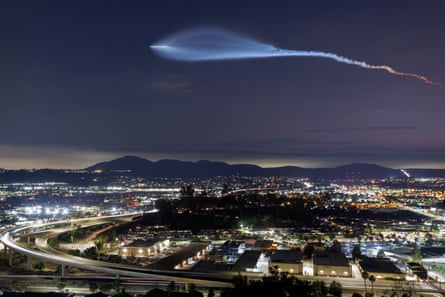 A SpaceX rocket carrying 24 Starlink internet satellites launches into space from California in 2025. Photograph: Kevin Carter/Getty Images
theguardian.com
A SpaceX rocket carrying 24 Starlink internet satellites launches into space from California in 2025. Photograph: Kevin Carter/Getty Images
theguardian.com
 ‘The alternation of light … is one of the oldest organising principles of life on Earth.’ Photograph: Eivaisla/Getty Images/iStockphoto
theguardian.com
‘The alternation of light … is one of the oldest organising principles of life on Earth.’ Photograph: Eivaisla/Getty Images/iStockphoto
theguardian.com
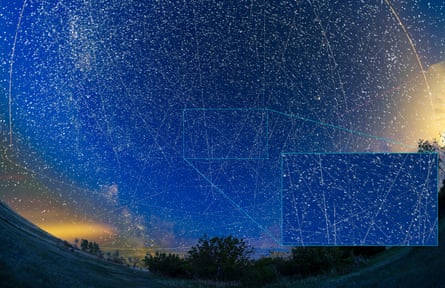 A blend of exposures showing all the satellites in a crowded sky from Alberta, Canada, in June 2022. Photograph: Alan Dyer/Getty Images/Stocktrek Images
theguardian.com
A blend of exposures showing all the satellites in a crowded sky from Alberta, Canada, in June 2022. Photograph: Alan Dyer/Getty Images/Stocktrek Images
theguardian.com
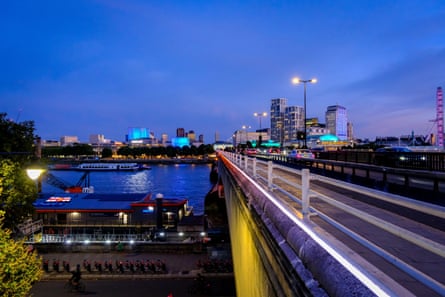 Waterloo Bridge in London. Prof Martino says circadian systems are ‘sensitive to light levels far below what humans typically perceive as bright’. Photograph: DA Cameron/Alamy
theguardian.com
Waterloo Bridge in London. Prof Martino says circadian systems are ‘sensitive to light levels far below what humans typically perceive as bright’. Photograph: DA Cameron/Alamy
theguardian.com
Plans to put “sunlight on demand” into Earth’s night sky are moving from speculative geoengineering to live regulatory filings.
According to The Guardian, the US Federal Communications Commission is reviewing a proposal from Reflect Orbital, a start-up that wants to deploy satellites with large reflective surfaces to redirect sunlight onto targeted areas at night. The company says it could illuminate patches roughly 5–6 km wide, with brightness adjustable “from full moon to full noon”, marketed for evening solar generation, construction, disaster response and agriculture.
The same FCC docket has also become a venue for broader alarm about scale. The presidents of four scientific societies in chronobiology—representing about 2,500 researchers across more than 30 countries—warned in letters that the cumulative effect of large reflective satellites and a sharp expansion of low-Earth-orbit constellations could “significantly alter the natural night-time light environment at a planetary scale”, the paper reports. Their core claim is not about stargazing aesthetics but biology: most organisms evolved around a reliable light–dark cycle, and small changes in night-time illumination can shift sleep timing, hormone secretion and behaviour.
The researchers point to knock-on effects that are hard to price in advance. Humans’ circadian systems are sensitive to light at night; so are many animals whose migration, breeding and feeding depend on darkness. Plants use night as a metabolic phase; seasonal timing depends on day length. In the ocean, planktonic organisms and phytoplankton—at the base of food webs—respond to light patterns and lunar cycles. The letters urge the FCC to require a full environmental review and to set limits on both satellite reflectivity and cumulative night-sky brightness.
Regulatory procedure matters here because it sets the default for the entire sector. Once one operator is approved, the next applicant can argue precedent, while the environmental impact becomes a shared externality: the costs of brighter nights are dispersed globally, while the revenue from “illumination-as-a-service” is captured by a small number of firms. The Guardian notes that DarkSky International has also written to the FCC, arguing that proposals that sound like science fiction are already being processed as routine licensing questions.
For Reflect Orbital, the pitch is narrow and local—illumination only for locations “approved by local authorities”—but orbital light does not respect municipal boundaries. The issue is less whether a given town wants extra light than whether a regulator can credibly evaluate what happens when night becomes an adjustable setting.
The FCC has not yet ruled on the applications. The letters now in its files treat darkness as infrastructure: once altered, it is difficult to restore.