
Israeli settler pressure tightens around Taybeh, west bank Christian town
Reports arson raids and blocked farmland access, diplomats become the only harvest escort
Images
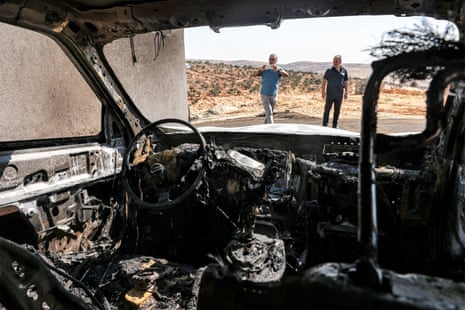 Men stand near a vehicle that was reportedly torched by Israeli settlers during an overnight attack on the Palestinian Christian village of Taybeh, northeast of Ramallah in the occupied West Bank, on July 28, 2025 Photograph: Zain Jaafar/AFP/Getty Images
theguardian.com
Men stand near a vehicle that was reportedly torched by Israeli settlers during an overnight attack on the Palestinian Christian village of Taybeh, northeast of Ramallah in the occupied West Bank, on July 28, 2025 Photograph: Zain Jaafar/AFP/Getty Images
theguardian.com
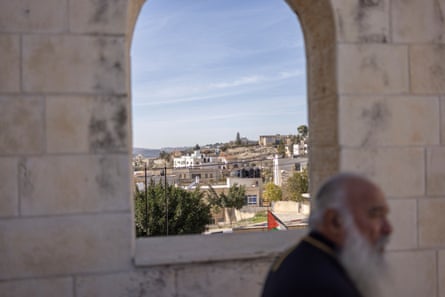 A photo taken from Saint George Greek Melkite Catholic Church shows parts of the mostly Christian town of Taybeh, in the Israeli occupied West Bank, days before Christmas festivities on December 22, 2025 Photograph: Ilia Yefimovich/AFP/Getty Images
theguardian.com
A photo taken from Saint George Greek Melkite Catholic Church shows parts of the mostly Christian town of Taybeh, in the Israeli occupied West Bank, days before Christmas festivities on December 22, 2025 Photograph: Ilia Yefimovich/AFP/Getty Images
theguardian.com
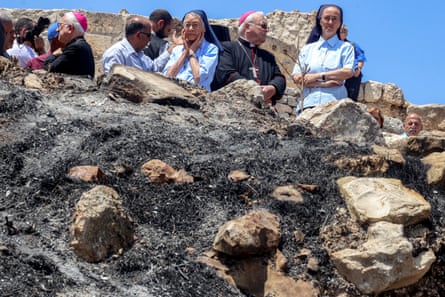 Catholic nuns and members of the clergy stand at the fifth-century Church of St George in the Palestinian Christian village of Taybeh, northeast of Ramallah in the occupied West Bank on July 14, 2025, during a visit by the head clergymen of several Christian denominations days after an arson incident on the site reportedly by Israeli settlers Photograph: Zain Jaafar/AFP/Getty Images
theguardian.com
Catholic nuns and members of the clergy stand at the fifth-century Church of St George in the Palestinian Christian village of Taybeh, northeast of Ramallah in the occupied West Bank on July 14, 2025, during a visit by the head clergymen of several Christian denominations days after an arson incident on the site reportedly by Israeli settlers Photograph: Zain Jaafar/AFP/Getty Images
theguardian.com
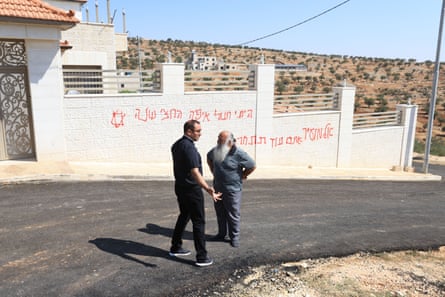 A spray-painted graffito reading "Al-Mughayyir, you will regret it later" in the Palestinian Christian viilage of Taybeh near the West Bank city of Ramallah, 28 July 2025. According to the Palestinian news agency Wafa, Israeli settlers attacked the village of Taybeh and set two vehicles on fire and spray-painted racist slurs on walls Photograph: Alaa Badarneh/EPA/Shutterstock
theguardian.com
A spray-painted graffito reading "Al-Mughayyir, you will regret it later" in the Palestinian Christian viilage of Taybeh near the West Bank city of Ramallah, 28 July 2025. According to the Palestinian news agency Wafa, Israeli settlers attacked the village of Taybeh and set two vehicles on fire and spray-painted racist slurs on walls Photograph: Alaa Badarneh/EPA/Shutterstock
theguardian.com
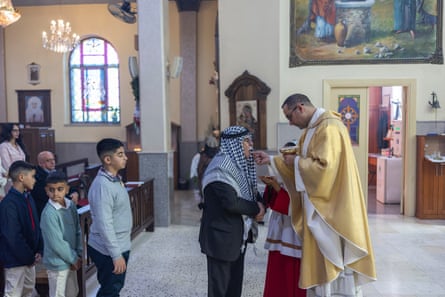 Abouna Bashar Basiel performs Christmas morning mass at the Christ the Redeemer Church in Taybeh, in the Israeli-occupied West Bank on December 25, 2025 Photograph: Ilia Yefimovich/AFP/Getty Images
theguardian.com
Abouna Bashar Basiel performs Christmas morning mass at the Christ the Redeemer Church in Taybeh, in the Israeli-occupied West Bank on December 25, 2025 Photograph: Ilia Yefimovich/AFP/Getty Images
theguardian.com
Israeli settlers have intensified pressure on the Palestinian Christian town of Taybeh in the occupied West Bank, with residents describing raids, arson and the effective loss of access to farmland that has sustained the community for generations. According to The Guardian, settlers set fire to the grounds of a fifth-century Byzantine church last year, and “hilltop youth” have since carried out repeated attacks including torching vehicles, slashing tyres and smashing windows. Clergy in Taybeh say roughly 30 settlers also moved to seize a concrete factory and stone quarry on the town’s edge in March.
Taybeh’s predicament sits inside a wider pattern: settlement expansion is no longer only about housing units inside authorised blocs, but about a mesh of outposts, grazing herds and intimidation that changes what is usable land on a day-to-day basis. In Taybeh, the immediate mechanism is mundane rather than ideological—cows and sheep driven into olive groves, farmers deterred from harvesting, and property damage that raises the cost of staying. The Guardian reports locals now venture into surrounding fields mainly when accompanied by diplomats from the French and Italian consulates, a workaround that underscores who can move safely and who cannot.
The incentives are straightforward. Unofficial outposts can be established quickly and defended on the ground; reversing them requires sustained policing and political will. For residents, each incident—burned cars, broken windows, a church compound set alight—functions as a private tax on daily life, while the legal process for land disputes and enforcement runs on a different clock. When access to agricultural land becomes sporadic, family income drops, younger residents leave, and the demographic “solution” arrives without a formal decree.
Internationally, Taybeh also complicates the usual framing of the conflict. Christian communities have often served as a bridge in Western diplomacy, and their displacement turns a territorial dispute into a visible religious and cultural contraction. The UN has described parts of the West Bank campaign as ethnic cleansing, The Guardian notes, and Israeli hardliners in government—including finance minister Bezalel Smotrich and national security minister Itamar Ben-Gvir—have been associated with policies and rhetoric that align with settlement entrenchment.
In Taybeh, the community that survived crusaders, Ottoman rule and the British mandate now says it cannot reliably reach its own olive trees. The only regular protection mentioned is a few days each harvest season when foreign diplomats arrive to walk the fields.