
US search for missing F-15E crew member continues in Iran
Tehran publicises reward and claims fire on rescue assets, hostage leverage grows as Hormuz deadline tightens
Images
 A file photo of two F-15E Strike Eagle jets
bbc.com
A file photo of two F-15E Strike Eagle jets
bbc.com
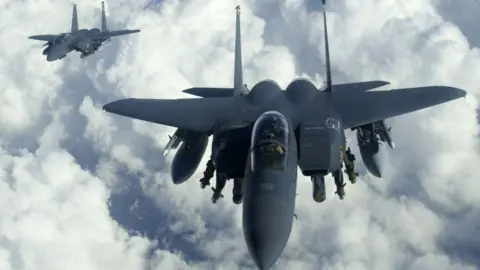 A file photo of two F-15E Strike Eagle jets
bbc.com
A file photo of two F-15E Strike Eagle jets
bbc.com
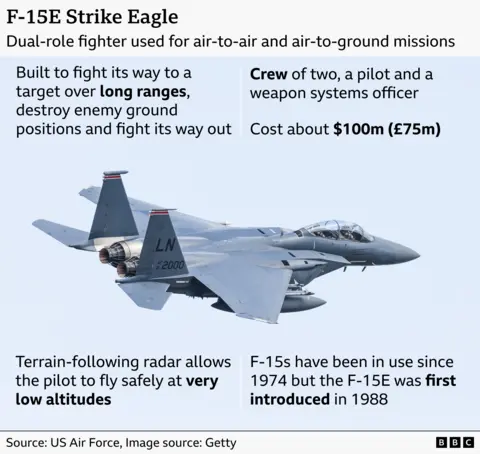 Infographic about the US F‑15E Strike Eagle fighter jet with a photo of the aircraft in flight and text explaining its features: designed for long‑range missions to attack ground targets and fight its way out; has a two‑person crew of a pilot and a weapon systems officer; uses terrain‑following radar to fly safely at very low altitudes. Notes that F‑15s have been in service since 1974, with the F‑15E introduced in 1988. States an approximate cost of $100m (£75m). Source: the US Air Force.
bbc.com
Infographic about the US F‑15E Strike Eagle fighter jet with a photo of the aircraft in flight and text explaining its features: designed for long‑range missions to attack ground targets and fight its way out; has a two‑person crew of a pilot and a weapon systems officer; uses terrain‑following radar to fly safely at very low altitudes. Notes that F‑15s have been in service since 1974, with the F‑15E introduced in 1988. States an approximate cost of $100m (£75m). Source: the US Air Force.
bbc.com
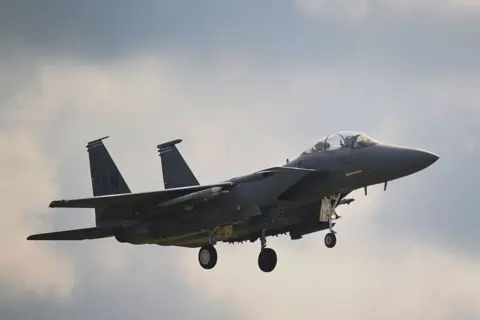 One of two crew members of the downed F15 Eagle is still missing
bbc.com
One of two crew members of the downed F15 Eagle is still missing
bbc.com
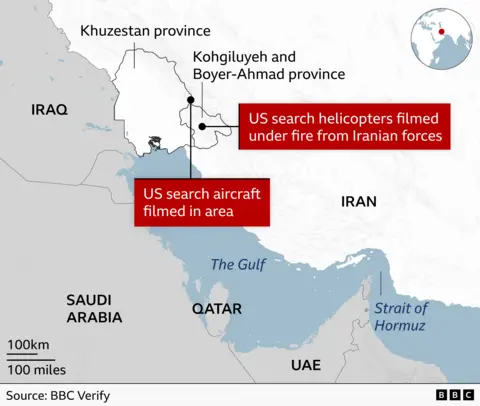 The image is a news-style map focused on southwestern Iran and nearby regions. It highlights Khuzestan province and Kohgiluyeh and Boyer-Ahmad province in Iran, near the border with Iraq. Red labels indicate reported incidents: “US search helicopters filmed under fire from Iranian forces” in Kohgiluyeh and Boyer-Ahmad province. “US search aircraft filmed in area” near Khuzestan. The map also shows nearby countries including Saudi Arabia, Qatar, and the United Arab Emirates. Key geographic features include The Persian Gulf and the Strait of Hormuz. Overall, it’s illustrating the location of reported US search operations and alleged Iranian engagement in southwestern Iran, based on BBC Verify reporting.
bbc.com
The image is a news-style map focused on southwestern Iran and nearby regions. It highlights Khuzestan province and Kohgiluyeh and Boyer-Ahmad province in Iran, near the border with Iraq. Red labels indicate reported incidents: “US search helicopters filmed under fire from Iranian forces” in Kohgiluyeh and Boyer-Ahmad province. “US search aircraft filmed in area” near Khuzestan. The map also shows nearby countries including Saudi Arabia, Qatar, and the United Arab Emirates. Key geographic features include The Persian Gulf and the Strait of Hormuz. Overall, it’s illustrating the location of reported US search operations and alleged Iranian engagement in southwestern Iran, based on BBC Verify reporting.
bbc.com
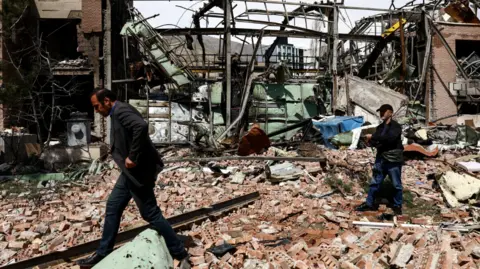 Research buildings at Tehran's Shahid Beheshti University were among the targets of Israel and US bombardments on Saturday
bbc.com
Research buildings at Tehran's Shahid Beheshti University were among the targets of Israel and US bombardments on Saturday
bbc.com
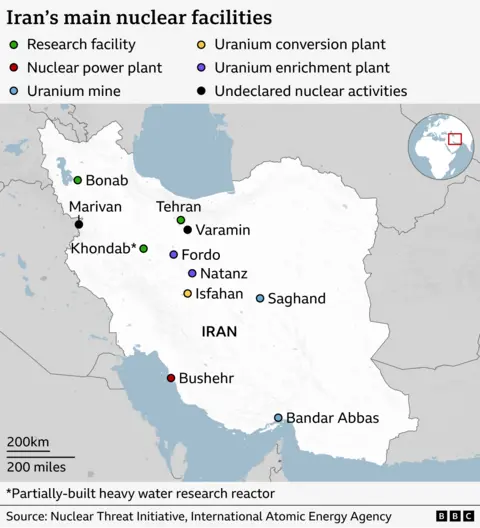 Map showing Iran's main nuclear sites
bbc.com
Map showing Iran's main nuclear sites
bbc.com
A US F-15E Strike Eagle was shot down over southern Iran on Friday, leaving one crew member still missing as US and Iranian forces run parallel search operations, according to the BBC and Reuters. US media said the pilot was rescued, while the aircraft’s weapons systems officer has not been accounted for; Iranian officials have urged citizens to help capture him alive and have publicised a reward. The incident comes as President Donald Trump publicly renewed a 48-hour deadline for Iran to accept a deal and reopen the Strait of Hormuz, threatening that “all hell” would follow if it does not.
The downing punctures a central claim from Washington that Iran’s air defences have been blunted to the point that US aircraft can operate with near impunity. As the BBC notes, combat search-and-rescue is among the most complex missions the US runs, and it quickly becomes a political event when the missing person is alive, identifiable, and potentially capturable. Iranian state-linked outlets have also claimed that US rescue assets were engaged and came under fire, including reports of an A-10 involved in the effort being hit and a helicopter taking small-arms fire—details the US has not publicly confirmed. BBC Verify reported it had authenticated video appearing to show armed individuals firing at helicopters, underscoring how quickly local militias, tribes, or opportunistic actors can become part of a state-level crisis.
If Iran or Iran-aligned forces secure the missing officer, the war’s centre of gravity shifts from air strikes to bargaining leverage. The BBC points to the domestic memory of the 1979 hostage crisis and to later prisoner swaps that were criticised for encouraging further hostage-taking. That history matters because it creates two pressures at once: to escalate in order to deter future captures, and to negotiate in order to recover a service member. Either route has costs that are hard to price in advance, which is why adversaries treat captives as strategic assets rather than battlefield by-products.
The timing also collides with a widening target set. The BBC reports Iranian authorities saying the area around the Bushehr nuclear power plant has been struck again, with one employee killed, while the IAEA said it had been informed of the strike and reported no rise in radiation levels. Russia, which helped build Bushehr and supplies fuel, has begun evacuating remaining staff, according to the report. Even when a reactor is not the intended target, repeated impacts near critical infrastructure raise the probability of an accident that insurers, shippers, and foreign contractors cannot ignore.
For now, the operational question is simple: who reaches the missing officer first. The political consequence is just as concrete.
Iran is offering cash for a living American airman while the US says Tehran must reopen Hormuz within 48 hours.