
Abandoned mountain lion cub rescued in Santa Monica mountains
Oakland Zoo puts three-week-old Crimson in intensive care, habitat squeeze turns wildlife care into routine logistics
Images
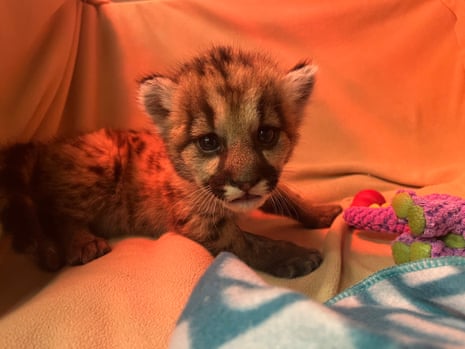 Crimson, a mountain lion cub, was abandoned by his mother in the Santa Monica mountains. Photograph: Oakland Zoo
theguardian.com
Crimson, a mountain lion cub, was abandoned by his mother in the Santa Monica mountains. Photograph: Oakland Zoo
theguardian.com
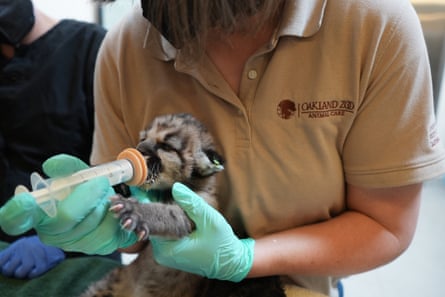 Veterinarians at the Oakland Zoo feed Crimson, a male mountain lion cub abandoned in the Santa Monica mountains. Photograph: Oakland Zoo
theguardian.com
Veterinarians at the Oakland Zoo feed Crimson, a male mountain lion cub abandoned in the Santa Monica mountains. Photograph: Oakland Zoo
theguardian.com
A three-week-old mountain lion cub found alone for days in California’s Santa Monica mountains has been rescued by federal biologists and transferred to the Oakland Zoo for intensive care, according to the Guardian.
The cub, later named Crimson, was spotted repeatedly without its mother inside the Santa Monica Mountains National Recreation Area. National Park Service biologists, who track a small and closely monitored mountain lion population in the range, revisited the site several times before concluding the mother had likely moved dens and left the cub behind. By the time the decision was made, the animal was visibly weakening and losing weight.
In consultation with the California Department of Fish and Wildlife, the biologists intervened and transported Crimson to the Oakland Zoo’s veterinary hospital in late March. The zoo’s chief executive, Nik Dehejia, told the Guardian the cub arrived emaciated and unable to stand, small enough to fit into cupped hands. Staff placed him in an intensive care unit and began bottle-feeding every three hours to stabilise him.
The immediate mystery is why a mountain lion would abandon a cub at such an early stage. Dehejia said it is rare and that definitive answers are often unavailable in wildlife cases. One hypothesis raised by the zoo is that a physical abnormality—Crimson is missing toes—may have signalled to the mother that the cub would struggle to survive.
Crimson is the 33rd mountain lion the Oakland Zoo says it has taken in. Another young mountain lion, a three-month-old named Clover, is also currently at the facility. The zoo emphasised it prefers cubs to remain with their mothers for nursing and social development, but described a rising flow of distressed animals linked to broader pressures on habitat.
Those pressures are not abstract in the Santa Monica mountains. The range is hemmed in by dense urban development and major roads, creating fragmented territory where large carnivores are forced into smaller, riskier spaces. Even when animals are not directly injured, the monitoring and rescue pipeline becomes a kind of downstream service for the way the region is built: biologists locate, assess and sometimes remove animals that cannot be left where they are.
For now, the Oakland Zoo’s task is straightforward: keep Crimson alive long enough to grow. The zoo says it will take weeks before staff can consider introducing him to Clover, a pairing that could provide companionship for two animals that would normally be raised in a litter.
Crimson was found alone, losing weight, and calling out in the brush; he is now on a three-hour feeding cycle inside a veterinary ICU.