
Iran claims it shoots down second US F-35
UN Security Council readies Hormuz shipping vote, verification gap widens as insurance and credit price the war
Images
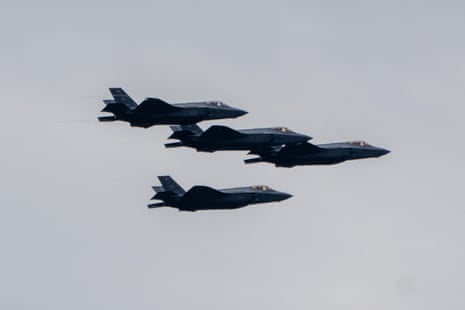 A flight of F-35 fighter jets earlier this year. Photograph: Andrew Leyden/ZUMA Press Wire/Shutterstock
theguardian.com
A flight of F-35 fighter jets earlier this year. Photograph: Andrew Leyden/ZUMA Press Wire/Shutterstock
theguardian.com
Iranian state media said on Friday that its air defences had shot down a second US F-35 fighter jet over central Iran, an assertion carried by Reuters and reported in the Guardian’s live coverage. The claim surfaced as the UN Security Council prepared to vote on a resolution aimed at protecting commercial shipping through the Strait of Hormuz.
If true, the downing would mark a sharp escalation in a conflict that has already pushed risk pricing from the battlefield into the plumbing of trade. A fifth-generation aircraft is not just a platform but a political symbol: losing one is expensive, but admitting it can be even more costly if it implies that air superiority is contested. Tehran’s statement also arrives in a context where attribution and verification are part of the fight; the Guardian notes there was no immediate US comment and it could not independently confirm the report.
The timing intersects with the Security Council debate over authorising a “defensive force” to secure passage through Hormuz, a chokepoint for global oil and LNG flows. In practice, shipping does not wait for speeches. Insurers, banks, and charterers decide whether a voyage is financeable, and they tend to move faster than diplomats. A credible threat to high-end aircraft and airbases changes those calculations because it suggests the conflict’s costs can rise unpredictably, not only for tankers but for the military cover meant to reassure them.
Iran has framed its posture as both regional retaliation and deterrence. The Guardian report describes Iranian strikes across the Middle East, including missiles launched at Israel and Bahrain, and drone attacks that it says set an oil refinery in Kuwait alight. Each additional target widens the set of actors who can retaliate, but it also widens the set of commercial assets that must be priced for loss—refineries, ports, storage, and the data and logistics systems that keep them running.
Washington, meanwhile, has recent form for acknowledging aircraft incidents without conceding combat losses. The Guardian notes that last month the US military said an F-35 made an emergency landing after a combat mission over Iran and that the pilot was stable. Tehran’s new claim—an air defence shootdown with “low chances” of pilot survival—tests whether the US will deny, confirm, or stay silent, and each option carries different downstream effects for allies, markets, and escalation management.
The Security Council vote will proceed either way. The immediate question for global trade is whether the next decision comes from New York—or from an underwriter deciding that the Strait is no longer insurable at any price.