
US strike destroys Iran B1 bridge
Trump claims responsibility for Tehran–Karaj suspension span, civilian infrastructure becomes the message channel
Images
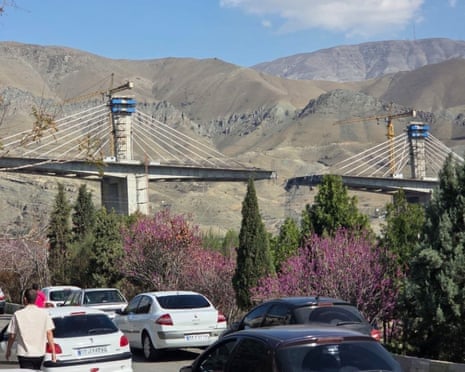 The B1 Bridge linking Karaj to Tehran, bombed by the US on 2 April. Photograph: X/MAMLEKATE
theguardian.com
The B1 Bridge linking Karaj to Tehran, bombed by the US on 2 April. Photograph: X/MAMLEKATE
theguardian.com
A reported US strike has destroyed Iran’s newly completed B1 suspension bridge between Tehran and Karaj, with Iranian state media saying eight people were killed and 95 wounded. Donald Trump posted video of the span collapsing and claimed responsibility, writing on Truth Social that there would be “much more to follow” if Iran did not reach a settlement. The Guardian reports the bridge was a $400m project and roughly 136 metres high, and that the central section was hit twice, leaving a visible gap in later imagery.
The strike marks a shift from attacking launch sites and military infrastructure to hitting the kind of prestige civil-engineering project that a state uses to signal competence. A bridge is not an airbase: it is daily logistics, commuter flow, and a public symbol. It is also easy to verify from afar, which matters in a war where Iran has repeatedly restricted information flows; the Guardian notes Iran’s authorities have shut down the internet, complicating independent confirmation of strikes and casualties. If the goal is to pressure Tehran’s leadership, visible damage to high-profile infrastructure creates domestic political costs without requiring an occupation or a decisive battlefield breakthrough.
Trump’s public messaging has oscillated between claiming the war is “nearing completion” and threatening to take out Iran’s power generation. In a White House address a day earlier, he said the US would hit “each and every one” of Iran’s electric plants “very hard and probably simultaneously,” a threat that would make civilian disruption an explicit instrument rather than collateral. The bridge attack sits on that spectrum: it is not a blackout, but it is a step toward targeting systems that civilians cannot route around.
Iran, for its part, has promised “more crushing, broader and more destructive” attacks, according to remarks cited by the Guardian from Ebrahim Zolfaqari, a spokesperson for the Iranian military’s Khatam al-Anbiya central headquarters. That language is familiar; what has changed is the pricing of risk across the region. Even when missiles are intercepted, debris still falls—recent strikes and interceptions have already pushed Gulf states and shipping markets into a higher-cost posture, and each additional escalation widens the set of assets that must be defended.
The Guardian also notes that footage of a strike on a missile base in Isfahan was confirmed as genuine, and repeats speculation that Iran may have moved part of its stockpile of 60% enriched uranium there. Trump, asked about the stockpile, said it was buried so deeply that “I don’t care,” though the report notes his history of misdirection. The war’s publicly stated objectives—degrading missile capacity, constraining nuclear capability, and forcing a political settlement—are being pursued through actions that are easier to demonstrate than to measure.
The B1 bridge was built to connect Tehran to Karaj. On Thursday, it became the war’s most visible piece of rubble.