
Bitcoin spot ETFs log $118m inflow streak
BlackRock IBIT dominates daily demand as crypto exposure shifts from wallets to fund plumbing
Images
 Bitcoin ETFs Extend Inflows With $118 Million as Ether Adds $31 Million
news.bitcoin.com
Bitcoin ETFs Extend Inflows With $118 Million as Ether Adds $31 Million
news.bitcoin.com
 Strong start to the week for bitcoin ETFs with $187 million in inflows over two days.
news.bitcoin.com
Strong start to the week for bitcoin ETFs with $187 million in inflows over two days.
news.bitcoin.com
 Bitcoin ETFs Rebound With $69 Million Inflow as Ether Ends Losing Streak
news.bitcoin.com
Bitcoin ETFs Rebound With $69 Million Inflow as Ether Ends Losing Streak
news.bitcoin.com
 Bitcoin ETFs Rebound With $69 Million Inflow as Ether Ends Losing Streak
news.bitcoin.com
Bitcoin ETFs Rebound With $69 Million Inflow as Ether Ends Losing Streak
news.bitcoin.com
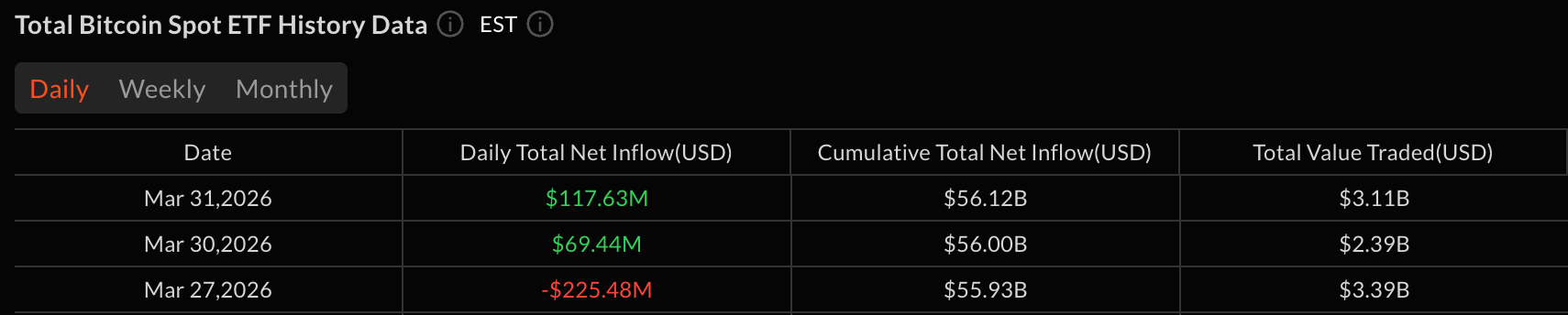
Bitcoin spot ETFs took in about $118 million in net inflows on Tuesday as the broader market tried to steady amid higher energy prices and war-risk headlines. According to Bitcoin.com News, BlackRock’s iShares Bitcoin Trust (IBIT) accounted for roughly $98 million of the day’s intake, with Fidelity’s FBTC adding about $16 million; no major fund reported outflows.
The numbers are small next to the early-2024 launch surge, but they matter because they arrive as other “safe” trades have been less reliable. In recent sessions, bond yields have jumped on renewed inflation fears tied to the Iran conflict and oil’s risk premium, while gold has not provided a clean hedge as investors have sold liquid assets to meet margin and funding needs. In that environment, ETF flows become less a referendum on bitcoin’s ideology than on plumbing: the easiest on-ramp tends to win whatever allocation is being made.
That plumbing has consequences. Spot ETFs concentrate custody and market access in a handful of venues and service providers, turning a supposedly decentralised asset into something that behaves like a conventional fund product. When the marginal buyer is an ETF, demand arrives in blocks and on a schedule, and the market’s microstructure shifts toward creations and redemptions rather than dispersed spot buying. A day with “no outflows” is not just sentiment; it is also a statement about who is not forced to sell.
The same report shows ether ETFs drawing about $31 million, again led by BlackRock, while XRP and Solana ETF products saw no trading activity. That split hints at a narrowing of risk appetite: capital is returning to the most liquid, most institutionally packaged crypto exposures, while smaller products sit idle.
For policymakers and banks, the question is less whether ETFs legitimise crypto than whether they make it easier to transmit shocks. If flows turn sharply negative, authorised participants can push selling pressure into the underlying market quickly, and the custody and settlement stack becomes a single point of operational risk. For asset managers, the appeal is the opposite: an instrument that can be bought and sold like a stock, with fees and spreads that can be priced, and with compliance boxes already ticked.
On Tuesday, that machinery produced a clean headline number—$118 million in inflows—while the rest of the market watched oil, rates and risk premiums move first.