
Colonial Pipeline gasoline line shuts after damage in Georgia
East Coast supply depends on a few high-volume corridors, war-driven oil risk meets domestic single points of failure
Images
 zerohedge.com
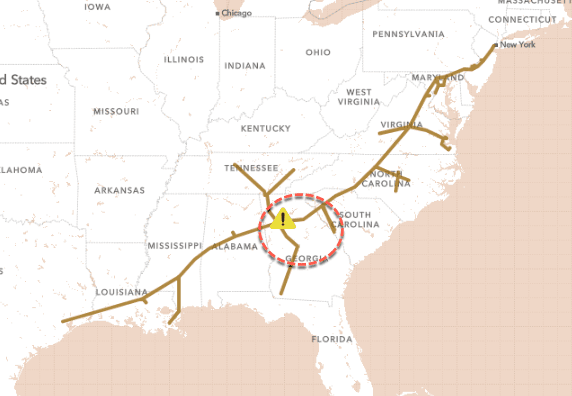
Colonial Pipeline’s main gasoline line from the US Gulf Coast to the Southeast stopped shipping fuel after a third-party crew damaged a section of the pipe in Paulding County, Georgia. The outage hit Line 1, a route that Bloomberg describes as moving roughly 1.5 million barrels a day of gasoline from the Houston area toward North Carolina, feeding an East Coast market with limited local refining capacity.
Colonial said Line 1 was out of service while it coordinated response and repairs, according to reporting cited by Zero Hedge. The rest of the Colonial system remained operational, but the incident landed in a market already pricing disruption risk from the US war with Iran. Reuters, covering investor reaction to President Donald Trump’s televised address, reported that stocks fell, the dollar strengthened and oil rose after Trump said US strikes would continue for “two to three weeks” and offered no clear timeline for restoring predictability around the Strait of Hormuz.
Taken together, the pipeline stoppage and the war commentary underline how thin the margin is between normal logistics and regional price spikes. The US does not have one national gasoline market; it has regional systems tied together by a few large conduits. When one of those conduits pauses, the adjustment happens through inventories, spot prices and trucking capacity—none of which scale instantly.
The East Coast’s dependence on long-distance supply is structural. Refining capacity is concentrated along the Gulf Coast, while consumption sits along the Atlantic seaboard. Pipelines like Colonial are the quiet middle layer that makes that geography workable. When the line is down, replacement supply moves by barge, rail or truck at higher unit cost, with timing constrained by terminals and driver availability.
Political reflexes tend to arrive faster than repairs: calls to “do something” about pump prices, demands for emergency waivers, and pressure on companies to prioritise optics over maintenance schedules. Those interventions can shave cents in the short run while teaching operators that every incident becomes a public inquiry, and every capital project carries regulatory and reputational risk.
Markets, meanwhile, price the risk in real time. Reuters noted that investors were looking for clarity on duration and escalation in the Iran conflict and did not get it. A damaged pipeline in Georgia does not change strategy in Tehran, but it does make the domestic cost of uncertainty more visible.
Colonial’s Line 1 stopped moving gasoline on Tuesday. The fuel still has to reach the East Coast somehow.