
King County reports first local TMVII fungal STI case
Rare Trichophyton mentagrophytes type VII spreads via skin contact and sex, surveillance surge may drive the next case count
Images
 fox13seattle.com
Public Health — Seattle & King County has identified a first local case of Trichophyton mentagrophytes type VII, a contagious dermatophyte that can spread through close skin-to-skin contact including sex. Fox 13 Seattle reports the agency expects more cases may be circulating undetected, after TMVII was previously documented in the US with an earlier New York case and a Minnesota cluster of roughly 30 cases.
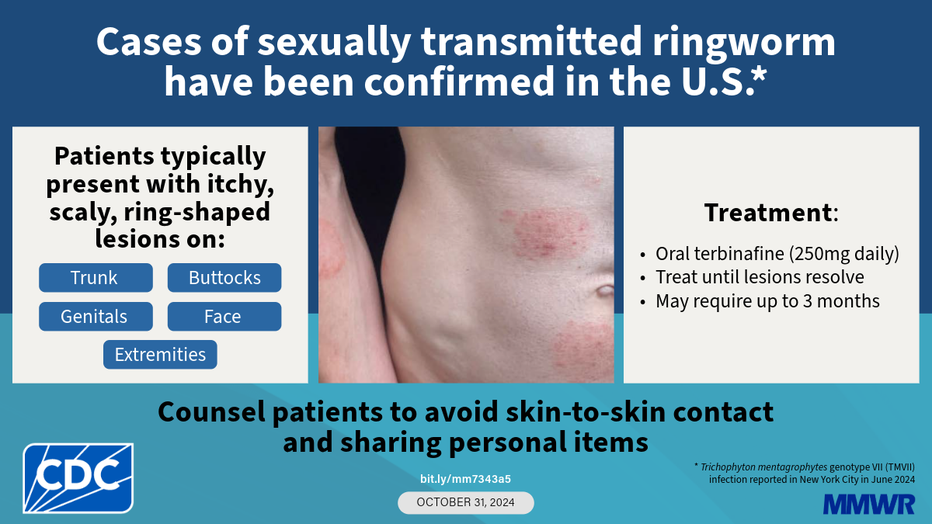
TMVII is essentially ringworm with a more stubborn treatment profile. The report describes rashes that may cluster in the groin or genital area, with intense itching and scaly, circular lesions. The practical problem for clinicians is not the diagnosis of “ringworm” in general but the mismatch between the organism and what many patients try first: over‑the‑counter topical antifungals. According to Dr Matthew Golden, cited by Fox 13, standard creams may fail and oral antifungals are often needed, with treatment stretching for weeks or months.
The public-health challenge is measurement as much as microbiology. A single confirmed case is a hard number; “likely circulating” is an inference that depends on how aggressively clinicians test, what labs can speciate, and whether patients present for care. A new name and a targeted alert can itself create a bump in reported incidence: clinicians look for it, labs run more confirmatory tests, and mild cases that would previously have been treated empirically become reportable.
That feedback loop matters because fungal STIs do not behave like viral outbreaks with a clear case curve. They sit at the intersection of sexual networks, contact patterns, and healthcare access. If oral treatment is required, costs and follow‑up become part of the epidemiology: patients who can’t get timely appointments or prescriptions stay infectious longer, while those with fast access get counted sooner.
For now, King County’s message is operational rather than dramatic: persistent genital-area rashes that do not respond to standard treatment should be evaluated by a clinician, and providers may need to consider TMVII when typical therapies fail.
The county has one confirmed TMVII case, and the warning is built largely on the expectation that testing will find what it has not previously looked for.